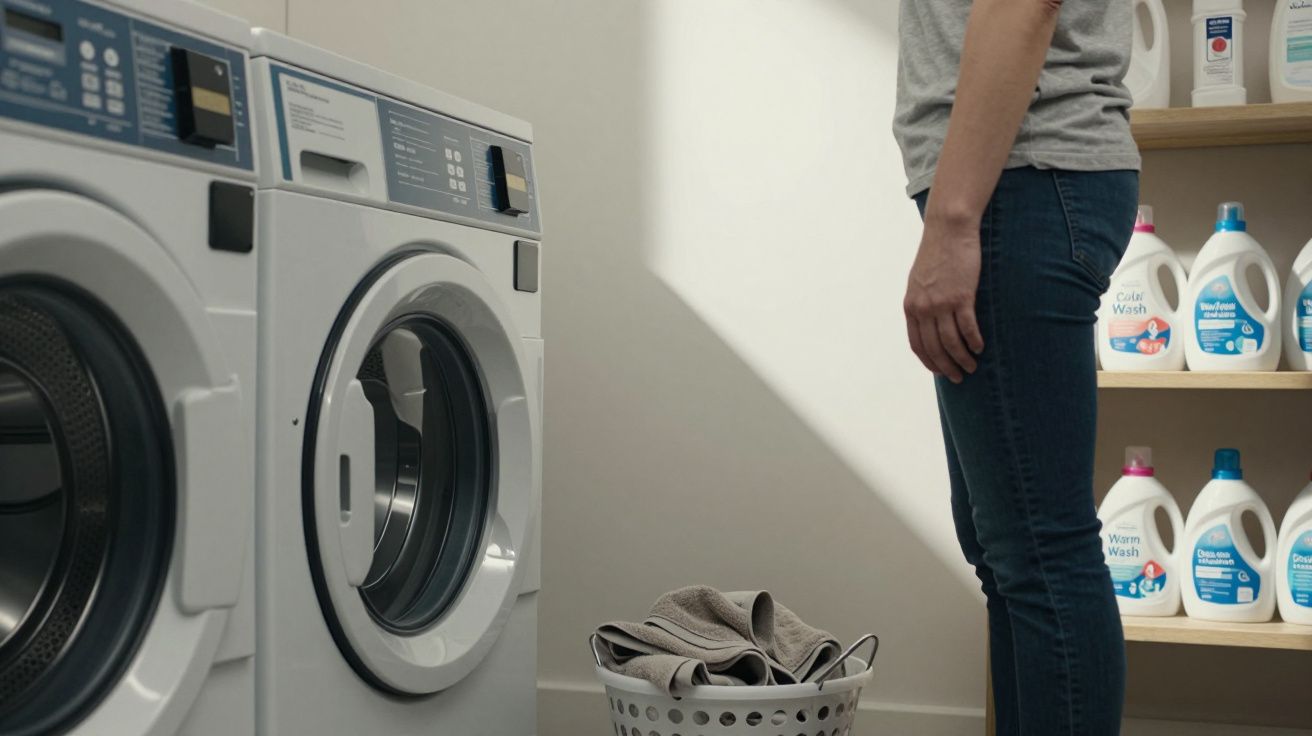
The towels came out heavier somehow-clean to the nose, but a flat, tired grey to the eye. You’d cranked the dial all the way to 90°C, added a bit more powder “for luck”, and waited for that hotel‑white finish. Instead: dulled borders, rough loops, and a nagging sense that they’d looked better before you tried to rescue them.
Boil washes feel like the nuclear option; an old‑school guarantee that germs and grime don’t stand a chance. Yet for modern fabrics, detergents and machines, that top setting often does the opposite of what you want. It can set stains, fade colours and leave whites more shadowed than shining.
Why hotter doesn’t always mean cleaner
Turn up the heat and dirt should dissolve faster. That’s the instinct. For years, 90°C cycles made sense for thick cottons, cloth nappies and hospital linen in primitive machines with basic soaps.
Today the chemistry has changed. Most household detergents are engineered to work best between 30–60°C. Enzymes that nibble away at proteins and fats start to break down above about 50–60°C. Optical brighteners that keep whites looking crisp can yellow or wash out when repeatedly cooked.
On a modern machine with a modern detergent, going straight to 90°C often means more damage, more greying and more energy for very little extra hygiene.
Heat alone does kill many microbes, but so do bleach additives, oxygen‑based stain removers and longer, cooler cycles. Past a point, extra temperature is just stress-for fibres, dyes and your energy bill.
What really happens inside a 90°C wash
A boil wash sounds dramatic because it is. Inside the drum, several things combine to dull fabrics over time.
- Fabrics swell and roughen. Cotton loops on towels fluff, then fray. Smooth sheets gradually lose their sheen as fibres are repeatedly scalded and abraded.
- Dyes let go. Even “colour‑fast” items can bleed a little at high temperatures. That loose dye doesn’t vanish; it has to settle somewhere-often back onto paler items in the same load.
- Stains can set. Protein‑based marks (blood, milk, egg, sweat) respond badly to boiling. High heat cooks them in, making later removal harder.
- Detergent residues bake on. Excess powder or liquid that didn’t fully dissolve at lower steps of the wash can dry onto fabrics in the intense final temperatures, leaving that stiff, grey cast.
And then there’s the machine itself. Repeated 90°C cycles can harden rubber seals, accelerate limescale in hard‑water areas and dislodge sludge from hidden corners of the drum. That loosened gunk has to go somewhere-often back into your “whites” as a faint grey veil.
The quiet culprit: soil redeposition
The main reason whites go dull isn’t that they’re suddenly dirtier. It’s that tiny particles of soil and dye get washed off, hang in the water, then slowly settle back onto fabric.
Think of it as a thin film, laid down wash after wash.
High temperatures can speed the breakdown of detergent ingredients that are meant to keep soil suspended. If those helpers lose strength half‑way through the cycle:
- Loosened dirt has more chance to reattach to fibres.
- Any dye that has bled out from a dark tag or stray sock can tint the whole load.
- Microscopic limescale, common in much of the UK, can trap pigments and body oils, creating that shadowy, grey tone.
Overdosing detergent and overfilling the drum make this worse. There’s simply not enough water to rinse everything away, so the wash turns into a hot, cloudy soup that your clothes sit in for far longer than they should.
If your whites emerge dull, it’s rarely because you “needed 90°C”. It’s more likely they needed the right dose, the right space and the right cycle at a lower temperature.
When a very hot wash still makes sense
Boil washes aren’t entirely obsolete. They’re just niche tools now, not default settings.
They can be useful for:
- Heavily soiled, all‑cotton items like reusable nappies, old‑school dishcloths or cleaning rags, if the care label allows 90°C.
- Hygiene loads after illness, particularly if someone has had diarrhoea or vomiting and you’re washing bedding and towels they’ve soiled.
- Occasional maintenance cycles with an empty drum, a cleaner or a scoop of soda crystals to help clear sludge and odours from the machine itself.
Even in those cases, many laundry experts and manufacturers now recommend 60°C with a bleach‑containing detergent as the practical upper limit for domestic hygiene. Several studies have found that 60°C with the right product is enough to reduce common germs to safe levels for household use.
The rule of thumb: reserve 90°C for rare, label‑approved cotton loads or machine cleaning. Don’t use it as a routine for towels, bedding or school uniforms.
What laundry experts suggest instead
Rather than blasting everything at 90°C, think in bands. Match the cycle to the fabric, soil level and goal (clean vs disinfect).
| Typical wash | Temperature | Notes |
|---|---|---|
| Everyday mixed clothes | 30–40°C | Use colour detergent, avoid overloading |
| Bed linen & towels | 40–60°C | 60°C for illness or if someone has allergies |
| Underwear, socks, tea towels | 40–60°C | Use a powder or capsule with bleach for hygiene |
| Delicates & sportswear | 20–30°C | Gentle or sports cycle, mild detergent only |
A few simple shifts give clearer results than cranking the dial:
- Whites: Wash whites together at 40–60°C with a detergent that contains optical brighteners and oxygen bleach (usually a biological or “whites” powder). Keep darks and colours firmly out of that drum.
- Colours: Stick to 30°C or 40°C with a liquid or colour‑care powder that doesn’t contain bleach. Heat is the enemy of vivid shades.
- Towels and bedding: 40°C for routine freshness, 60°C once in a while or after illness. Skip fabric softener on towels; it can coat fibres and reduce absorbency, making them feel limp rather than fluffy.
- Baby items: Follow the care label, usually 40°C or 60°C. Use a non‑bio if skin is sensitive, but still avoid overloading and consider an extra rinse.
How to stop greying without touching 90°C
You can often rescue and protect laundry with mechanical tweaks rather than thermal shock. Focus on five levers: load, dose, cycle, water and machine care.
1. Load the drum properly
Too full and clothes can’t move; too empty and they slap around, wearing faster.
- Aim for the drum to be about two‑thirds full when dry.
- You should be able to slide a flat hand on top of the laundry comfortably.
- Bulky items like duvets may need dedicated “duvet” or “bulky” cycles to get enough water and rinsing.
2. Dose detergent for your water and soil level
More detergent does not mean whiter laundry. In fact, it’s one of the quickest routes to greying.
- Check the box or bottle for the hardness level and soil rating; most UK areas are medium to hard.
- If your area is hard and whites are dull, consider:
- A water softener product or
- Moving to a powder specifically labelled for whites in hard water.
- For lightly soiled clothes, you can usually drop to the lower end of the recommended range.
If you often see suds on the door during rinses, you’re probably using too much.
3. Pick the right cycle length, not just temperature
Eco modes run cooler but longer, allowing detergents time to work. Quick washes save time but often skimp on rinsing.
Where possible:
- Use full, standard cycles for towels, bedding and anything that tends to grey.
- Reserve super‑short washes for lightly worn items you just want to freshen.
- If your machine allows, add an extra rinse for whites.
4. Look after the machine that looks after your clothes
A greyish tinge can be a sign your washer needs its own clean.
Simple routine:
- Once a month, run an empty hot wash (60–90°C) with a machine cleaner, a cup of white vinegar in the drawer or a scoop of soda crystals.
- Wipe the door seal and detergent drawer weekly; those black specks are mould and sludge.
- Leave the door and drawer ajar between washes so the drum can dry.
A clean machine rinses better. Better rinsing means less film on fabrics and fewer grey shadows over time.
5. Rescue whites that already look tired
If your whites are already more “ecru” than crisp, you can gently pull them back without resorting to constant boiling.
Try:
- A dedicated laundry whitener or oxygen bleach booster in a 40–60°C wash.
- Pre‑soaking very dull items in warm water with a scoop of oxygen bleach before a normal cycle.
- Avoiding chlorine bleach on everyday fabrics; it can weaken fibres and cause yellowing.
Do this once in a while, then keep up with smarter cycles to maintain the improvement.
A quick self‑check you can do this week
Pick one “problem” item: a pillowcase, a favourite T‑shirt, that pair of once‑white socks. Hold it next to something genuinely new and white (a paper envelope, a fresh tea towel). Look at:
- The seams: are they closer to the original colour than the main fabric?
- The elastic: does it feel stiffer or wavier than when new?
- Any faint stripes or shadows where it folds?
Those clues tell you if you’ve been over‑heating, over‑dosing or both. On your next wash, drop the temperature to 40°C, lighten the detergent measure slightly, use a full‑length cycle and leave more space in the drum. Then compare again.
You’re not giving up cleanliness; you’re trading raw heat for smarter chemistry and better rinsing. The reward is laundry that looks brighter for longer-and a 90°C setting that finally goes back to what it should be: an occasional specialist, not your everyday hammer.
FAQ:
- Is 90°C ever safe for clothes? Only if the care label clearly shows a 95°C or 90°C symbol and the item is all cotton or linen with no elastic or special finishes. Even then, reserve it for rare heavy‑duty washes, not weekly routines.
- Will 40°C really kill germs on bedding and towels? For normal household use, 40–60°C with a good detergent is usually enough. If someone is ill or has a weakened immune system, aim for 60°C with a bleach‑containing powder rather than jumping straight to 90°C.
- Why do my clothes still smell after lower‑temperature washes? Common reasons include an overloaded drum, too little detergent, a dirty machine, or leaving wet laundry sitting in the drum. Start by cleaning the washer, reducing the load size and running full‑length cycles at 30–40°C.
- Is a boil wash better for people with allergies? Not necessarily. Removing pollen, dust mites and detergent residues matters more than extreme heat. Regular 60°C washes for bedding, plus thorough rinsing and a clean machine, usually help more than frequent 90°C cycles.
- Does using lower temperatures save much energy? Yes. Dropping from 60°C to 40°C, and especially from 90°C to 60°C, can significantly cut the energy used per wash. Over a year of weekly loads, that adds up on your bill as well as reducing your environmental footprint.




Comments (0)
No comments yet. Be the first to comment!
Leave a Comment