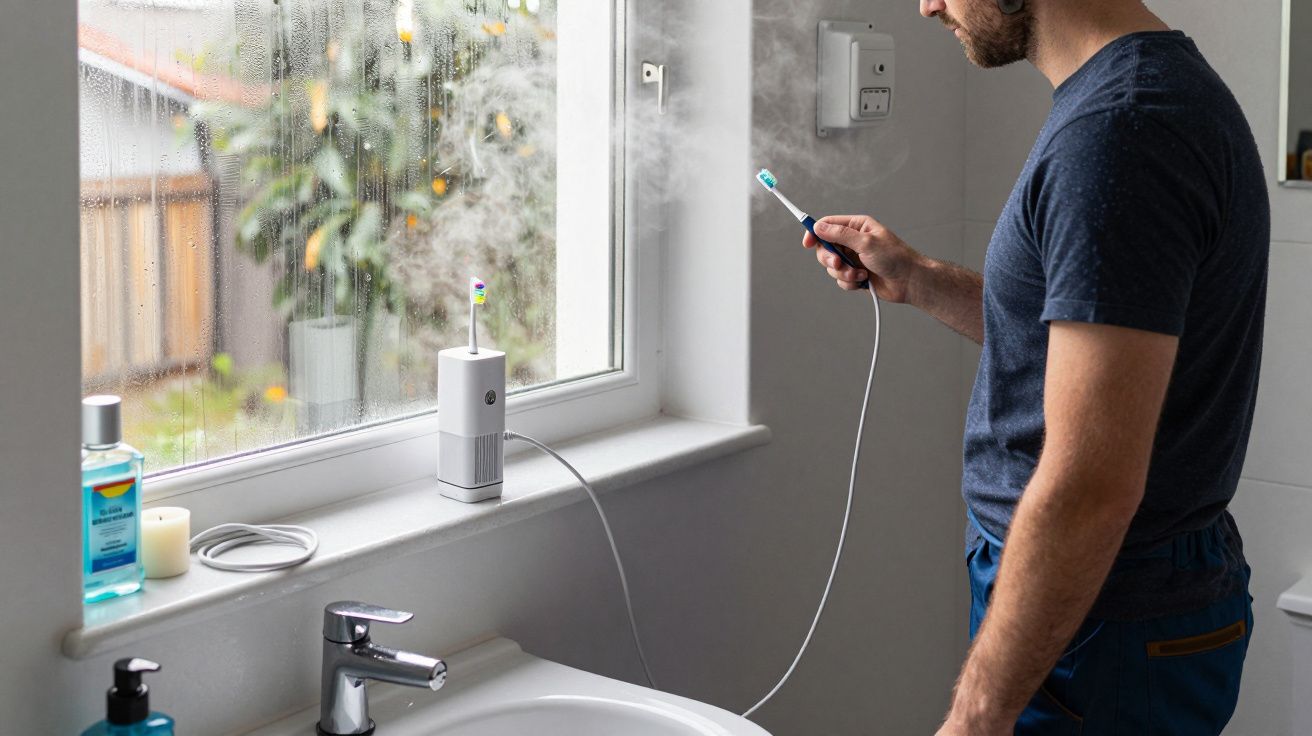
There’s a familiar scene in British bathrooms: a narrow windowsill, a misted mirror, a toothbrush base wobbling between a candle and a bottle of mouthwash. A white cable snakes across the sink to a chunky three‑pin plug, which disappears into an extension lead trailing in from the landing. The light flickers as someone boils the kettle downstairs. Steam rolls off the shower. The charger hums quietly on the damp sill.
An electrician walks in on a call‑out, spots the setup and winces. Not because they’re fussy about tidiness, but because this is exactly the kind of “it’s only a toothbrush” improvisation that wiring regulations are designed to stop.
Bathrooms feel like safe, domestic spaces. Legally, they’re treated more like small machine rooms full of water. And that matters every time you bring a plug within splashing distance of a tap.
The bathroom charging habit that makes electricians wince
Most modern electric toothbrushes and shavers arrive with a 2‑pin plug that’s designed for a shaver socket, not a normal 13A outlet. That’s deliberate. UK rules (BS 7671, if you like chapter and verse) heavily restrict standard sockets in bathrooms because water dramatically changes the risk profile of everyday electrics.
In practice, people often sidestep that design. Common workarounds include:
- using a 2‑pin–to–3‑pin adaptor and plugging into a bedroom socket, then running an extension into the bathroom
- buying a USB‑charged toothbrush and plugging the USB adaptor straight into a wall socket beside the sink
- adding a DIY 13A socket in the bathroom during a renovation “because the last house had one”
All of these feel convenient. They also ignore the specific way bathrooms are treated in UK wiring regulations.
A toothbrush charger may be low power, but once it’s on a 230 V socket in a damp room, it’s governed by the same safety rules as anything else.
The charger is not the real problem. The combination of mains power, moisture and the wrong location is.
Why damp and mains power are a bad match, even with modern kit
Electricians talk about “damp environments” as if the room itself is an ingredient in the circuit. In a bathroom, steam and splashes don’t just sit on surfaces; they creep into sockets, switches and plugs, slowly changing how electricity behaves.
Moisture lowers the resistance of your skin and of building materials. That means a fault current can take a path through you or through damp grout and framing instead of neatly returning along the intended cable. Condensation can:
- corrode contacts in chargers and adaptors
- create tiny conductive films across surfaces
- encourage mould growth, which itself can hold moisture
Modern installations use RCD protection and double‑insulated appliances. Those are crucial backstops, not force fields. RCDs reduce the severity of a shock; they don’t make it impossible. A charger that’s left permanently in a steamy room can degrade over time until a harmless‑looking knock or splash is enough to expose live parts.
The USB myth doesn’t help either. People often assume, “It’s only USB, that must be safe in the bathroom.” The device may charge at 5 V, but the little white block in the wall is still a mains transformer. If that sits in the wrong place, it’s the 230 V side that matters.
Low wattage doesn’t mean low risk when the environment is doing half the work of the fault.
How bathroom “zones” actually work
To stop all of this turning into guesswork, UK wiring rules divide bathrooms into zones. Electricians think in circles and boxes around the bath, shower and basin rather than seeing one uniform space.
Here’s the simplified picture:
| Zone | Where it is | What it usually means |
|---|---|---|
| 0 | Inside the bath or shower tray | Only very low‑voltage, specially rated kit |
| 1 | Directly above bath/shower up to 2.25 m | No standard sockets; only specific IP‑rated equipment |
| 2 | 0.6 m horizontally from edge of bath/shower, up to 2.25 m high | Limited equipment, must meet higher IP rating |
| Outside zones | Beyond Zone 2 | More options, but still with bathroom‑specific rules |
In plain English: the closer you are to where water lives or flies, the stricter the rules. The “damp zone” people talk about is essentially Zones 1 and 2, where splashes, spray and heavy steam are normal.
Some key points that surprise a lot of householders:
- Standard 13A sockets are not allowed in Zones 0, 1 or 2. In most typical UK bathrooms, that means no ordinary sockets at all.
- Shaver sockets are an exception, but only when installed to the correct zone limits and specifications. They are isolated by a transformer and strictly limited in power output.
- Light switches are usually pull cords or outside the bathroom for the same reasons.
That Instagram‑friendly toothbrush station balanced on the bath ledge or right next to the shower screen? It rarely satisfies this layout.
Where you should and should not charge your toothbrush
The upshot is simple: you can absolutely own and use an electric toothbrush in a British bathroom, but you need to be picky about where it lives and how it charges.
Safer charging options
A proper shaver socket
If you have a built‑in shaver socket that’s been installed to current regs, it’s the natural home for the standard 2‑pin charger. These outlets contain an isolating transformer and are specifically designed for low‑power grooming devices.A bedroom or landing socket
Many people keep the charging base on a bedroom chest of drawers or landing shelf, then carry the toothbrush into the bathroom when needed. It’s a tiny inconvenience that removes the mains‑plus‑moisture problem entirely.A charging stand in another dry room
For USB‑charged brushes, treat the charging block like a phone charger: use it in a dry room, not perched above a sink. Only the toothbrush itself should cross the bathroom threshold.
Spots to avoid, even if they “seem fine”
Electricians repeatedly flag these as red‑zone behaviours:
- trailing an extension lead from a bedroom into the bathroom, especially across a damp floor or near a radiator
- placing a mains adaptor or USB charger on the toilet cistern, bath edge, radiator or towel rail
- plugging a 2‑pin toothbrush charger into a cheap travel adaptor and leaving it in a steamy bathroom long‑term
- using a multi‑way adaptor in a bathroom to charge phones, razors and toothbrushes all together beside a basin
It may all work for months. The issue is what happens on the day something fails or water goes where it shouldn’t.
Common mistakes electricians keep seeing
Talk to working electricians and the same bathroom stories come up again and again. They are rarely about dramatic DIY bodge‑jobs and more about quiet, everyday improvisations.
Hidden “just one socket” upgrades
A previous owner or handy relative adds a 13A socket in the bathroom during a refit, often spurred from a nearby circuit. It looks neat, so everyone assumes it’s legal. It usually isn’t, and it may void both electrical certification and insurance if something goes wrong.The always‑plugged‑in charger on a steamy sill
The toothbrush base or shaver charger sits permanently near the basin, soaks up years of steam and toothpaste splatter, and eventually fails with a bang, a fizz or just a dead short. By the time anyone notices the corrosion, it’s already done its worst.Phone charging by the bath
Someone adds a high‑power USB adaptor “just for the toothbrush”, then slowly starts charging a phone on the same lead while scrolling in the bath. The risk profile jumps from “unwise” to “seriously dangerous” without any changes to the wiring.Assuming “IP‑rated” means “invincible”
A product box might boast splash resistance or a certain IP rating. That doesn’t mean the plug‑top charger or adaptor it came with is designed for a wet room, or that you can put a socket wherever you like.
Bathrooms are one of the few places in a home where “it’s been fine so far” tells you almost nothing about whether it’s safe.
A quick safety checklist before you plug in
Before you decide where your toothbrush lives, a 30‑second mental run‑through can stop the worst mistakes:
Is any mains plug, adaptor or extension actually inside the bathroom?
If yes, ask whether it has to be, or whether the charger can move to a dry room instead.Is the charger within splash or spray range of a tap, shower or bath?
If you could hit it with a flannel from the tub, it’s too close.Is there visible condensation, rust or discolouration on the plug, charger, or shaver socket?
That’s a sign it’s time for replacement or inspection.Was any bathroom socket definitely installed and tested by an electrician?
If you’re not sure, assume you need a professional to look at it.Could a child or pet knock water onto the charger or pull it into a sink?
If so, rethink the layout. Stability matters as much as distance.
None of this means your electric toothbrush is a problem in itself. The UK rules are really about where you draw the invisible line between “wet zone” and “mains world”.
FAQ:
- Are shaver sockets completely safe in bathrooms?
They’re safer by design because they use an isolating transformer and limited output, and they’re allowed under UK wiring regs when correctly installed. But like any electrical fitting, they can age or be installed badly, so signs of damage, overheating or looseness mean it’s time to call an electrician.- Can I install a normal 13A socket in my bathroom if it’s far from the bath?
In most typical UK bathrooms, no. Standard sockets are generally not permitted within the room’s zones, which for many small bathrooms covers almost all of the space. Any proposal to add a socket needs a qualified electrician who understands the regulations and can confirm whether your specific layout allows it.- Is it OK to charge a toothbrush from a portable power bank in the bathroom?
A small, battery‑only power bank (with no mains connection while you’re in the room) removes the mains‑plus‑moisture issue, so it’s broadly safer than a plugged‑in charger. You still need to keep it away from direct water and avoid dropping any electrics into a full bath or basin.- Who should I speak to if I’m unsure about my bathroom electrics?
In the UK, look for a registered electrician (for example with NICEIC, NAPIT or similar bodies). They can check whether your bathroom setup complies with BS 7671, advise on shaver socket locations, and suggest safe options for charging grooming devices without turning a toothbrush into a hidden hazard.




Comments (0)
No comments yet. Be the first to comment!
Leave a Comment