The email lands with a soft ping just as the daylight disappears. You’re on the sofa, wrapped in a blanket you bought in a sale, watching the little spinning icon while your latest gas and electricity bill loads. You already know it’s going to be worse. It always is.
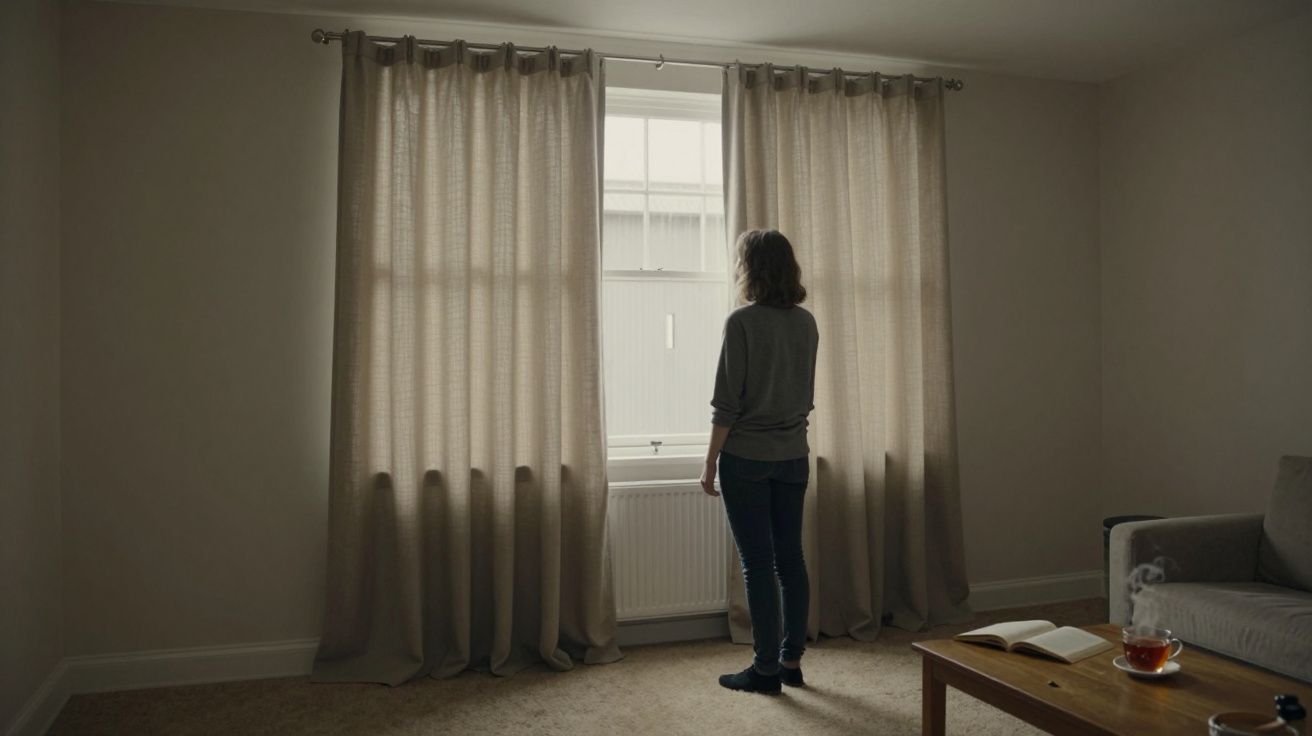
You look up. The radiators are on. The room should feel cosy. Instead there’s that familiar chill around your legs, a faint breath of cold dropping from the windows. The curtains are drawn, but they balloon slightly, as if something is moving behind them. Warm air, quietly leaking away.
Later that week, at a friend’s house, you notice something odd. Same old British terrace, same age of windows, same grey sky outside. But in their living room, it actually feels warm - and the thermostat is at 18°C. The difference is almost invisible: the way their curtain rod is placed, and how the fabric falls.
It doesn’t look like a heating hack. Yet it is.
How your curtains might be quietly stealing your heat
Most UK homes have a familiar set‑up: radiator under the window, curtain rod a few centimetres above the frame, curtains that just skim the sill or hover above the radiator. It looks tidy. It’s also a perfect design for wasting warmth.
Here’s what happens. The radiator heats the air immediately above it. That warm air wants to rise and circulate into the room. But if your curtains hang in front of the radiator, the hot air goes up behind the fabric instead. It collects in a warm little bubble between curtain and window, then cools as it hits the cold glass, and sinks as a draught back into the room.
You’ve effectively put your radiator outside the living space.
The result is a room that never quite feels comfortable unless you nudge the thermostat up “just a bit”. That “bit” shows up on your bill. And all the while, your curtains are trying - and failing - to act as insulation.
The good news: a tiny change in where the rod sits can flip this script. Without touching the boiler settings at all.
The curtain‑rod adjustment that creates a hidden blanket of warmth
Think of your curtains as a soft, moveable wall. Done right, they can:
- Trap a layer of still air in front of the cold glass (extra insulation), and
- Let warm air from the radiator flow freely into the room.
The trick is to make the fabric hug the window area and miss the radiator’s mouth. You do that with three small tweaks:
Raise the curtain rod
Move the rail or pole higher - ideally 10–20 cm above the top of the window frame, or as high towards the ceiling as you reasonably can. This reduces the gap where warm air can sneak behind the curtain and hit the cold glass.Widen the rod beyond the window
Extend the rod 10–20 cm past each side of the window. This allows you to park the open curtains fully clear of the radiator during the day, and at night ensures the fabric overlaps the wall, not just the glass. That overlap is what creates a snug “air pocket”.Use returns so curtains curve back to the wall
A “return” is simply the way the curtain turns back towards the wall at each end, rather than hanging straight down in mid‑air. You can get brackets with a built‑in return, or cheat with a small hook on the wall that the last curtain ring clips into. It stops warm air leaking out at the sides.
Those three changes do something powerful and very simple: they create a controlled pocket of air between fabric and glass, without imprisoning your radiator behind a curtain.
The radiator now heats the room; the curtain now insulates the window. Each does its own job, rather than cancelling the other out.
Soyons honnêtes : personne ne pense à son tringle à rideaux en ouvrant sa facture. Yet this is one of the rare “home hacks” that is cheap, quick, and based on basic physics rather than wishful thinking.
How to do it in under an hour (even if you’re renting)
You don’t need to redesign the room. You just need to nudge things a few centimetres.
1. Look at one window properly
Stand back and notice:
- Do the curtains hang in front of the radiator?
- Is there a gap at the top where you can feel a draught?
- Do the curtains stop above the sill, leaving glass exposed?
A cold, slightly fluttery feeling around your ankles when the heating is on is a big clue.
2. Move the rod up and out
If you’re able to drill:
- Mark a new line for the brackets 10–20 cm above the current position (or just below the coving/ceiling).
- Shift each bracket 10–20 cm outwards so the rod is wider than the window.
- Fill the old holes later if you need to; a tiny dab of filler goes a long way.
If you’re renting or avoiding drills:
- Use no‑drill tension rods inside deep window recesses for a second, inner curtain closer to the glass.
- Or use adhesive hooks slightly higher and wider to hold a light pole or wire for an extra layer (voiles, fleece panels) behind your existing curtains.
The aim is the same: one layer close to the glass, one layer that doesn’t smother the radiator.
3. Create side returns
This is where heat often escapes.
- Add a small hook or adhesive tab on the wall 5–10 cm in from each end of the rod.
- When you draw the curtains, clip the last ring or eyelet to this hook so the fabric hugs the wall.
It looks like a minor detail. It stops warm air sneaking round the edges and keeps the “air pocket” calm and still - exactly what you want for insulation.
4. Check the length
Ideally, winter curtains should:
- Just kiss the window sill, or
- Drop to the floor if they are not in front of a radiator, or
- Stop just above the top of the radiator if the radiator sits fully inside the curtains’ span.
If your curtains are too short, you can add:
- Iron‑on hemming tape and a strip of cheap fleece or thermal lining at the bottom.
- Clip‑on curtain rings with clips to attach a separate lining panel behind.
None of this needs to be beautiful. It’s about making a more solid “soft wall” where the cold is coming from.
5. Change the daily rhythm
The timing matters more than people think:
- Open fully when the sun is out – pull the curtains right back past the window so the glass and room can soak up whatever weak winter sun appears.
- Close as soon as it’s getting dark – don’t wait until bedtime. The outdoor temperature drops; your fabric barrier should already be in place.
It’s a small habit. Over a whole season, it adds up.
Tiny extras that amplify the effect (still no thermostat touched)
Once the rod and curtains are doing their job properly, a few modest add‑ons can improve the “warm bubble” around your windows even more:
Thermal linings or fleece throws
Clip or pin a fleece throw or purpose‑made thermal lining to the back of existing curtains. This thickens the insulating layer dramatically for very little money.Draught‑proof the bottom edge
If air whistles in at the window sill, roll a towel or use a simple draught excluder against the base of the curtains and frame. It stops your carefully‑warmed air escaping under the “soft wall”.Radiator reflector panels
Behind radiators on external walls, slim reflective panels bounce heat back into the room instead of letting it soak into the brickwork. They’re cheap, and they quietly support the work your curtains are doing.Window film on the coldest panes
Clear insulating film (the kind you shrink with a hairdryer) effectively adds a layer of “invisible glazing”. Combined with snug curtains, it can lift the perceived warmth of a room by more than the numbers on the thermostat suggest.
None of these changes alter your boiler settings. They simply make every unit of heat you do pay for work harder before it vanishes outside.
What this means for comfort - and your bill
Energy experts often quote a rough rule of thumb: turning your thermostat down by 1°C can cut heating costs by around 7–10% over a season. The reality in many homes is that we turn it up by 1°C because certain rooms never feel quite right.
The curtain‑rod adjustment attacks that problem from the other end. By:
- Reducing cold draughts falling from windows,
- Stopping radiators from warming the space behind curtains,
- Keeping more heat circulating at sitting level,
…you can often sit comfortably at a slightly lower thermostat setting, or simply avoid nudging it higher on grim evenings. You may not see a dramatic overnight drop on the bill. You may notice that you are not turning the dial as often.
More importantly, the room feels different. The chair by the window is no longer the cold seat nobody wants. The evening chill that used to creep in at 9pm arrives later, or not at all. The heating periods you already pay for go further.
It’s a modest, very British kind of win: invisible to visitors, quietly obvious to you.
Key ideas at a glance
| Key idea | Detail | Why it helps |
|---|---|---|
| Raise and widen the rod | 10–20 cm higher and wider than the window | Lets radiators heat the room while curtains insulate the glass |
| Add side returns & linings | Curve curtains back to the wall; clip on thermal layers | Traps a still “air pocket” and stops heat leaking round the edges |
| Change the routine | Curtains wide open in sun, closed at dusk | Uses free solar gain and cuts evening heat loss without touching the thermostat |
FAQ:
- Will moving my curtain rod really make a noticeable difference? In many typical UK rooms with radiators under windows, lifting and widening the rod so curtains clear the radiator and hug the window can noticeably reduce draughts and cold spots. It won’t replace insulation, but it can be the difference between “I need to turn this up” and “this is fine” on a lot of evenings.
- What if my curtains have to hang over the radiator? Focus on creating an extra inner layer close to the glass (tension rod, wire, or film) and keeping the outer curtains slightly shorter so they don’t trap heat directly above the radiator. Side returns and draught‑proofing the sill still help.
- Do I need special “thermal” curtains? Not necessarily. Heavier fabrics and proper linings insulate better, but even ordinary curtains work far harder if the rod is positioned well and gaps are reduced. You can cheaply upgrade existing curtains with clip‑on fleece or thermal linings.
- I’m renting and can’t drill new holes - is there any point? Yes. Use no‑drill tension rods or adhesive hooks for an extra layer inside the recess, add draught excluders, and make sure you close everything at dusk. Even temporary adjustments can improve comfort without upsetting your landlord.
- Is this enough on its own to cut my energy bills? It’s one small piece of a bigger puzzle: insulation, draught‑proofing, sensible thermostat use, and efficient boilers all matter. The curtain‑rod adjustment is attractive because it’s cheap, quick, and works with what you already have, helping every other measure you take go a little bit further.




Comments (0)
No comments yet. Be the first to comment!
Leave a Comment