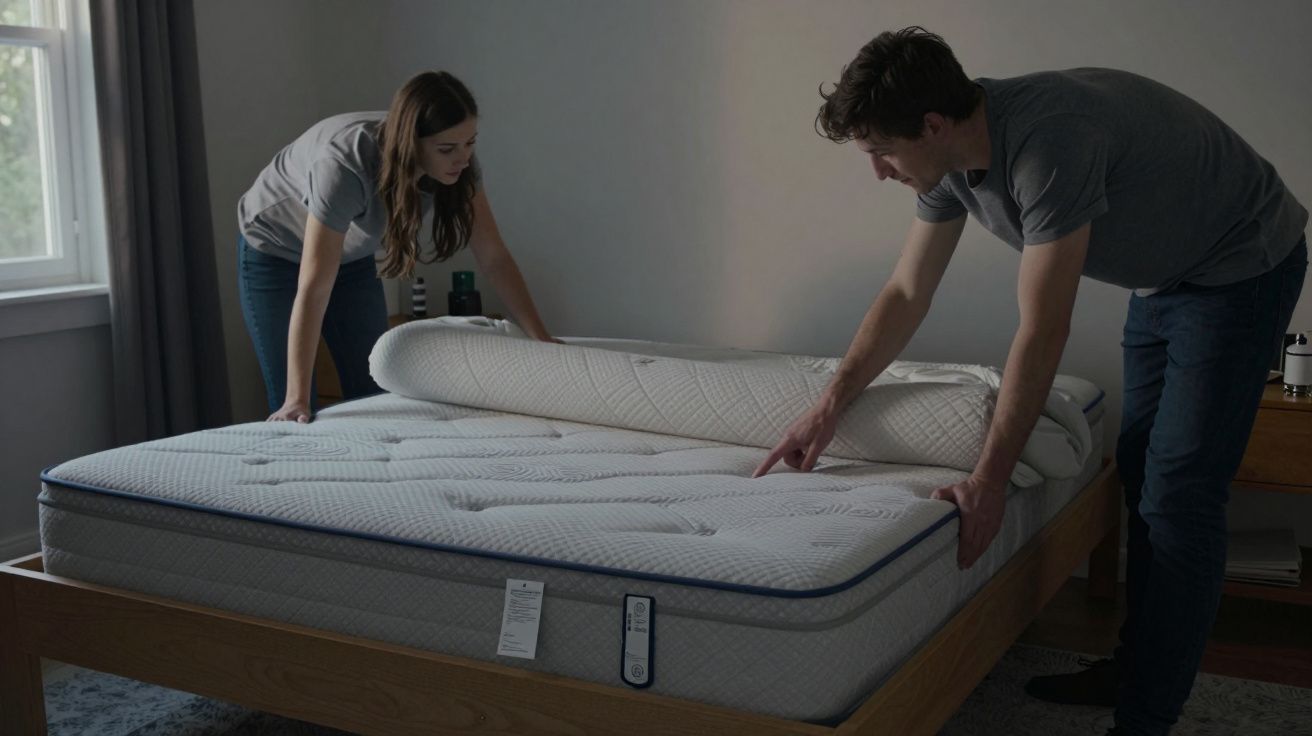
On a tired Sunday evening, you finally strip the bed, half-wrestling a king-size mattress that weighs roughly the same as a small car. Someone on the other side of the frame calls “Ready? One, two… lift!” and you both heave, shuffle and swear until the whole thing flops over with a hollow thud. A stiff corner catches your wrist, a fabric tag brushes your face, and for half a second you glimpse tiny symbols and microscopic text you’ve never properly read.
You smooth the sheet, collapse into bed, and notice the surface feels oddly different – lumpier here, harder there. “It’ll settle,” you mutter, blaming the long day rather than the fact you’ve just turned a one-sided, pillow-top mattress completely upside down.
Two weeks later, there’s a shallow dip where you always sleep and a new ache in the small of your back. You ring the retailer, convinced the mattress is “faulty”. The person on the phone asks you to read the care label. You squint: “No turn. Rotate only.” There’s a little circular arrow you’d always assumed was a logo. Silence. Then the phrase nobody wants to hear: “I’m afraid that kind of use can void the warranty.”
It turns out the most expensive piece of furniture in many bedrooms comes with a set of instructions hidden in plain sight. A secret code stitched to the side, written in icon-speak and fine print, that most of us ignore until something feels wrong.
The instructions hiding on the side of your mattress
For decades, mattresses were simple: two usable faces, a bit of padding, a firm core, and the standard advice from grandparents and guesthouse owners alike – “flip it every season”. That mental model is still lodged in a lot of heads. The problem is that the industry quietly moved on.
Modern mattresses are often built like a cake with a very clear top and bottom. Pillow-tops, zoned springs, layered foams and integrated toppers are designed in a specific order, on a specific side. Flip them and you’re not “refreshing” the bed; you’re sleeping on the underside of the recipe.
Manufacturers know this, which is why they now sew small, dense care labels into the border. In theory, they’re doing you a favour: those tags explain how to stop the mattress ageing before you do. In practice, the instructions are usually read once (at best), on delivery day, while the driver waits with a clipboard and you’re still looking for clean pillowcases.
Quietly, the stakes are higher than most people realise. Retailers report that a chunk of complaints about sagging, ridges or overheating trace back to simple misuse – flipped the wrong way, never rotated, or parked directly on slats that are too far apart. And because the evidence is sewn on in black and white, warranties often sit on the side of the label, not the sleeper.
What those tiny codes actually mean
If you crouch down and really look at the label, you’ll usually find the same small group of phrases and icons. Once you decode them, the whole thing suddenly makes sense.
Common clues include:
- “No turn” / “Rotate only” – sometimes next to a circular arrow running head-to-foot.
- Two straight arrows at either end of a rectangle (the mattress) – rotate end-to-end.
- A curved arrow flipping over a rectangle – you’re meant to flip the mattress.
- Snowflake / sun symbols – winter and summer sides, often with different fabrics.
- “This side up” / “Sleeping surface” – the face you should actually lie on.
Underneath, you may see a schedule in small print: “Rotate weekly for first 3 months, then every 3 months.” That isn’t legal boilerplate. It’s the user manual most households never follow.
Here’s how to read the main signals:
| Label clue | What it’s telling you to do | Why it matters |
|---|---|---|
| “No turn” + circular arrow | Never flip it over. Rotate 180° head-to-foot on a schedule. | Built with a dedicated top: flipping crushes comfort layers and voids many warranties. |
| “Turn regularly” + flip icon | Flip it over and rotate periodically (there are two sleeping sides). | Spreads wear across both faces and evens out body impressions. |
| Sun / snowflake icons | Use one side in warmer months, the other in colder months. | Different quilting or fibres manage heat and moisture by season. |
If you’re staring at a tangle of symbols and still feel lost, there’s a simple rule of thumb: if one side is obviously more cushioned, patterned or plush, it’s probably not meant to be turned over. True double-sided mattresses look almost identical on both faces, with tufts or quilting mirrored front and back.
A five-minute label check that could add years to your mattress
You don’t need to become a mattress engineer. You just need one calm moment with the tag.
Try this small ritual the next time you change the sheets:
- Strip everything off – duvet, pillows, topper, protector. Expose the bare mattress.
- Find the care label – usually sewn into a side seam near a corner or handle.
- Read it out loud – especially phrases like “no turn”, “rotate only”, and any timing (“every 4 weeks”).
- Take a quick photo with your phone so you don’t have to crawl on the floor every time you forget.
- Set gentle reminders – for example:
- First 3 months: rotate every 2 weeks.
- After that: rotate every 3 months.
- If it’s a genuine two-sided mattress: alternate between a flip and a rotate.
Think of it less as a chore and more as brushing your mattress’s teeth. Not glamorous, not daily, but the kind of thing future-you is grateful you quietly did.
If the weight of the mattress makes you want to give up before you start, adjust the plan, not your back:
- Clear space around the bed so you’re not tripping over bedside tables.
- Work in pairs when you can; agree which direction you’re turning before you lift.
- For heavy hybrids, try a “clockwise shuffle”: lift one corner at a time and walk it around, rather than trying a full aerial somersault.
If we’re honest, most households don’t follow a perfect rotation schedule. But even doing it twice a year, roughly when the clocks change, puts you ahead of the vast majority of people and can noticeably even out wear.
Turn it, don’t torture it
When manufacturers talk about “misuse”, they’re not imagining wild scenarios. They’re talking about very normal things people do without realising the impact.
Some of the most common:
- Flipping a one-sided pillow-top so the soft quilting ends up face-down, compressed against the base. The underside you now sleep on was never designed for that. Result: hard patches, collapsed edges and fast fatigue in the comfort layers.
- Never rotating at all, so your full weight hits the same pocket springs, foam cells or fibre pads every night. Over time those components soften where you lie and remain firm where you don’t, creating a trench that isn’t actually “a manufacturing defect” – it’s a map of your habits.
- Bending or folding the mattress sharply to get it round a staircase or under a bed to hoover. Many models, especially with springs, have frames or border wires that don’t survive being creased in half.
- Parking it straight on widely spaced slats or an old sprung base that sags in the middle. The mattress then follows the dip and keeps it, however carefully you rotate.
Inside, the structure is more deliberate than it looks. Firmer zones are often placed under your hips and lower back, with softer ones near shoulders and legs. Flip a zoned, one-sided mattress and you reverse the entire architecture. The bed hasn’t “gone wrong”; it’s just been asked to work upside down.
From the outside, all of this can feel like a manufacturer’s trick – a way to blame you instead of their product. The quieter truth is more mechanical: foam, fibre and steel behave in predictable ways under long-term load. Use the layers the way they were drawn on the design table, and they last longer. Fight the blueprint, and they complain faster.
Between comfort, warranty and the stories we tell in bed
There’s a small tug of war playing out on every mattress label: tradition versus design.
On one side is the inherited script: “A good mattress should be flippable; anything else is cheap; just turn it every few months and stop fussing.” On the other is what a lot of current models actually are: one-sided constructions where comfort, support and temperature control are carefully stacked in a particular order.
Both have a point. Your grandmother’s advice was right for the thick, tufted, completely symmetrical mattress she grew up with. It’s simply not right for a 2024 pillow-top with zoned springs and a breathable top panel you’re meant to lie on, not bury against a divan.
You don’t have to pick a side in the argument to protect your back and your bank balance. You just need to know which story your own bed belongs to.
A few quick rules of thumb:
- Looks the same both sides, tufts on each face, no “no turn” text? Likely double-sided. Flip and rotate on a loose seasonal schedule.
- One side clearly plusher with a built-in topper, fancy quilting or a label that literally says “sleep surface”? Treat as no-flip. Rotate only.
- Memory foam or deep comfort foam on top of a dense, plain base layer? Again, usually rotate-only. Flipping puts you on the base, not the bed.
- Still unsure? When in doubt, never flip – just rotate. That choice very rarely voids a warranty; flipping the wrong model often can.
In a way, the label is about more than foam, springs and legal small print. It’s a quiet reminder that you have more influence over your own comfort than you think. A two-minute read, a calendar nudge, a slightly awkward shuffle round the bed every so often – they’re small gestures that say: this isn’t just a big rectangle I collapse on. It’s a piece of equipment I’m in charge of.
| Key point | Detail | Why it matters |
|---|---|---|
| Read the code once | Decode “no turn”, “rotate only”, icons and timing on the care label. | Stops you accidentally voiding protection or ruining a good mattress. |
| Match habit to design | Double-sided models get flipped; one-sided models just rotate. | Aligns your routine with how the mattress is built, not old myths. |
| Little, regular moves | Gentle, periodic rotations rather than emergency measures when it sags. | Extends usable life and can improve comfort night after night. |
FAQ:
- How often should I rotate or flip my mattress?
Follow the label first, but a common pattern is: every 2 weeks for the first 3 months (while materials settle), then every 3 months. Double-sided mattresses can alternate between rotating and flipping; one-sided models are usually rotate-only.- How can I tell if my mattress is actually double-sided?
Strip it completely and inspect both faces. If they look and feel the same, with similar quilting or tufts on each side and no “no turn” warning, it’s likely double-sided. If one face is clearly more finished or cushioned, assume it’s one-sided unless the label says otherwise.- Have I ruined it if I’ve already flipped a ‘no turn’ mattress?
Not necessarily. Flip it back so the correct side faces up, then rotate following the maker’s guidance. Check for obvious damage (broken stitching, distorted edges) and, if you’re worried about the warranty, take photos and contact the retailer for advice.- Does ignoring the care label really void the warranty?
Many warranties include conditions about correct support (slats, base) and following rotation or no-turn instructions. If a complaint is clearly linked to misuse, the claim can be rejected. Keeping the label intact and, ideally, a note or reminder of your rotations, can help if you ever need to prove you’ve followed the rules.- Do mattress toppers or protectors change how I should care for the bed?
They don’t usually change the flip/rotate instructions, but they can reduce wear and protect against spills, which in turn helps with warranty claims. Rotate or flip the topper itself periodically as well, especially if it’s foam, so it wears evenly along with the mattress underneath.





Comments (0)
No comments yet. Be the first to comment!
Leave a Comment