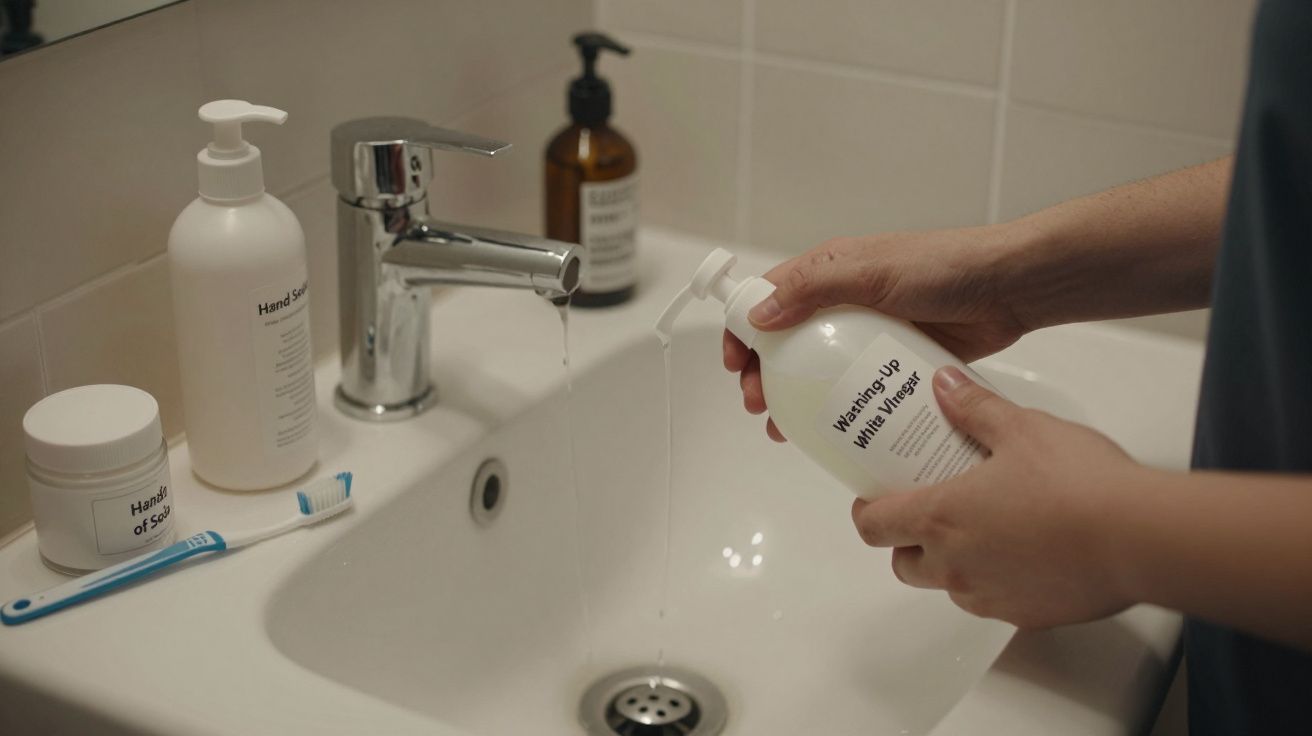
The first sign is rarely dramatic. A small halo of water around the plug, the way the toothpaste foam takes a second too long to vanish, that faint ring that appears no matter how often you wipe the basin.
You run the tap, watch the swirl hesitate, and feel the familiar twitch: grab the bleach, maybe a kettle of boiling water for good measure. “Give it a blast,” as someone once told you.
Plumbers, watching this at a distance, wince a little.
What they actually reach for in their own bathrooms is far less exciting: two ordinary bottles you probably already own, used in a very particular order. No bleach, no boiling water, no fizzing mystery gel from the supermarket aisle. And it works not by burning through the blockage, but by unpicking it so your pipes stay intact.
Your sink doesn’t need drama. It needs chemistry on your side, not a small war under the plughole.
Why bleach and boiling water quietly punish your bathroom pipes
A slow bathroom sink is almost never about one big “lump” down there. It’s layers: hair, shaving foam, moisturiser, make-up, toothpaste, hard water minerals. Each day adds a film. Over months, that film becomes felt.
We picture bleach as the universal answer because it smells like “clean”. In a closed bathroom, you pour a cup down the drain, the fumes rise, your eyes sting a bit, and you assume something powerful is happening in the pipes. It is – just not what you think.
Bleach is good at disinfecting surfaces. It’s not very good at dissolving clumps of hair and soap scum. Most of that mat simply sits there, slightly whiter and more brittle, still stuck to the sides of the pipe. Worse, bleach reacts badly with other products. Mixed (even indirectly) with acidic cleaners, drain “openers”, or ammonia-based sprays, it can release chlorine or chloramine gas – the last thing you want hovering at face height over a tiny basin.
Then there’s the kettle trick. Boiling water feels satisfyingly decisive: 100°C, straight from hob to plughole. What most people don’t see is the rubber seal or plastic trap just below the surface. PVC waste pipes and the seals around them are designed for hot tap water, not repeated shocks of near‑boiling water from a kettle.
Over time, that thermal whiplash can:
- Soften or warp plastic pipes
- Crack inexpensive traps
- Harden and fatigue rubber washers until they start to seep
The irony is sharp: in the name of “taking care” of a slow drain, we quietly shorten the life of the very parts that keep everything watertight.
Ask a couple of domestic plumbers what they actually do in their own bathrooms between call‑outs, and the answer is almost boring: a degreaser, a mild acid, hot (but not boiling) water, and gravity. Two bottles, one simple routine.
The two‑bottle method plumbers actually trust
The good news: you don’t need anything exotic. The two‑bottle method is really just using the right chemistry in the right order.
Bottle 1: A strong washing‑up liquid
Any standard, high‑foaming washing‑up liquid in a squeezy bottle. Its job is to cut through the greasy film from moisturisers, shaving products and natural skin oils that glue everything together.Bottle 2: Plain white vinegar
Clear white vinegar (cleaning or food grade, 5–8% acetic acid). This helps dissolve soap scum and limescale – the hard, gritty layer that traps hair and slows water to a crawl.
Optional but helpful: a few spoonfuls of bicarbonate of soda in a jar. It’s not one of the “bottles”, but it turns the vinegar stage into a gentle, pipe‑safe scrub.
Step‑by‑step: one quiet clean‑out
Do this on a night when the sink won’t be used for an hour or so.
Clear the standing water
If the basin is already half‑full and barely moving, bail most of it into a bucket and tip that down a different drain or the loo. You want the pipe as exposed as possible.Dose with Bottle 1 (washing‑up liquid)
Squeeze a generous ring of washing‑up liquid around the plughole and directly into it – 2–3 good squirts, not just a token drop.
If your sink has an overflow (that little slit or hole near the top), aim a short squeeze into that too; it’s often lined with slime.Run the hottest tap – but not the kettle
Turn on the hot tap to its maximum and let it run for 30–60 seconds. You want very warm, steamy water, not boiling. This pulls a slick of soapy, degreasing water deep into the waste, loosening the oily film.
Then turn the tap off and leave it for 10–15 minutes. The mixture needs a little time to work rather than being flushed straight away.
Add bicarbonate (if you have it)
Sprinkle 2–3 tablespoons of bicarbonate of soda directly into the plughole. If you can, tap a teaspoon or so into the overflow as well. It doesn’t have to vanish; it will sit on the damp surfaces, ready for the vinegar.Follow with Bottle 2 (white vinegar)
Slowly pour about 250–500 ml of white vinegar down the plughole. Pour in stages, pausing if it foams up. If you added bicarbonate, you’ll see and hear it fizz as it loosens the grime.
Again, give a small splash to the overflow so that line is not forgotten.
Pop the plug in or lay a saucer over the hole for 20–30 minutes. You’re not trying to build pressure; you’re simply keeping the vapour and liquid in contact with the mess rather than letting it evaporate straight away.
- Flush with a single rush of hot tap water
Fill the basin with the hottest water that comes from the tap (not from the kettle) – right up to the overflow if you can. Then pull the plug in one go. That brief, heavy rush gives your newly loosened blockage a shove down the line.
In many cases, you’ll hear it before you see it: a deeper “glug”, then a cleaner, faster swirl as the water disappears.
If the sink is still slower than you’d like, repeat the whole sequence once more the next day. Stubborn, years‑old build‑up often needs two rounds.
When this won’t be enough
No honest plumber will pretend a couple of bottles can fix every problem. If:
- Water will not drain at all, or
- You see water backing up into the basin when another fixture (like the bath or loo) is used, or
- There’s a persistent bad smell even after cleaning
…then the issue may be further along the line, or there may be a solid object stuck in the trap. That’s the time for a drain snake, taking the U‑bend off, or calling someone with the right kit – not more chemicals.
Small habits that stop bathroom sinks slowing to a crawl
The real value of the two‑bottle method isn’t just the rescue; it’s how easy it is to turn into routine maintenance once a month, before the gurgling starts.
Most of what clogs a bathroom basin is predictable: hair, product, hard water. A few small tweaks change how much of that ever gets the chance to settle.
Catch the hair before it travels
A simple mesh or silicone drain cover in the basin catches stray hairs from shaving and styling. Empty it into the bin daily. It’s boring. It also saves pipes.Go easy on thick products at the sink
Heavy clay masks, oils and hair products are better rinsed in the shower, where the pipes are wider and the flow is stronger. The dainty little basin waste is easily overwhelmed.Run hot water after “heavy” use
After you’ve shaved, removed make‑up, or brushed with a high‑fluoride, pasty toothpaste, run the hot tap for 20–30 seconds. Think of it as “chasing” the sludge away before it cools and sticks.Do a quick two‑bottle mini‑flush monthly
One small squeeze of washing‑up liquid, a hot‑tap rinse, a cup of vinegar, then a hot flush ten minutes later – even without bicarbonate – keeps the inner lining of the pipe from ever getting thick enough to cause trouble.
“The difference between a pipe that lasts and one that cracks isn’t how much bleach you pour down it,” as one London plumber put it to me. “It’s how often you let it sit quietly with warm water and soap instead of boiling shock therapy.”
Over a year, these tiny, unremarkable choices spare you the Saturday spent with a bucket under the basin and a U‑bend in your hands.
| Key point | Detail | Why it matters |
|---|---|---|
| Skip bleach & kettles | Use degreasing soap, mild acid and hot tap water instead | Protects plastic pipes and seals while still clearing build‑up |
| Two‑bottle order | Washing‑up liquid first, then (optionally bicarb) then vinegar | Loosens grease, then breaks down soap scum and limescale |
| Regular light maintenance | Quick mini‑flush once a month + hair catching | Prevents slow drains before they become full blockages |
FAQ:
- Does this two‑bottle method work in kitchen sinks as well?
Yes, but kitchen blockages often contain more fat and food, so you may need an extra round and a bit more washing‑up liquid. Avoid if you suspect a solid object (like cutlery) is lodged in the trap.- Is vinegar safe for all types of pipes?
In the small amounts used here, standard white vinegar is generally safe for modern plastic and metal waste pipes. Avoid combining it with any other chemical drain cleaner, and never follow it immediately with bleach.- Can I just use boiling water on metal pipes?
Even with metal, the weak points are usually rubber seals and plastic connectors. Occasional hot‑but‑not‑boiling water is fine; repeated kettlefuls are what cause trouble over time.- What if I don’t have bicarbonate of soda?
The method still works. The washing‑up liquid plus vinegar and hot water will deal with a lot of everyday build‑up. Bicarbonate simply adds a gentle scrubbing action and makes the process a bit faster.- How often should I do a full two‑bottle clean?
For a typical household bathroom sink, once every 4–6 weeks as prevention is usually enough. If you style hair over the basin or have hard water, every 2–4 weeks can keep things flowing freely.





Comments (0)
No comments yet. Be the first to comment!
Leave a Comment