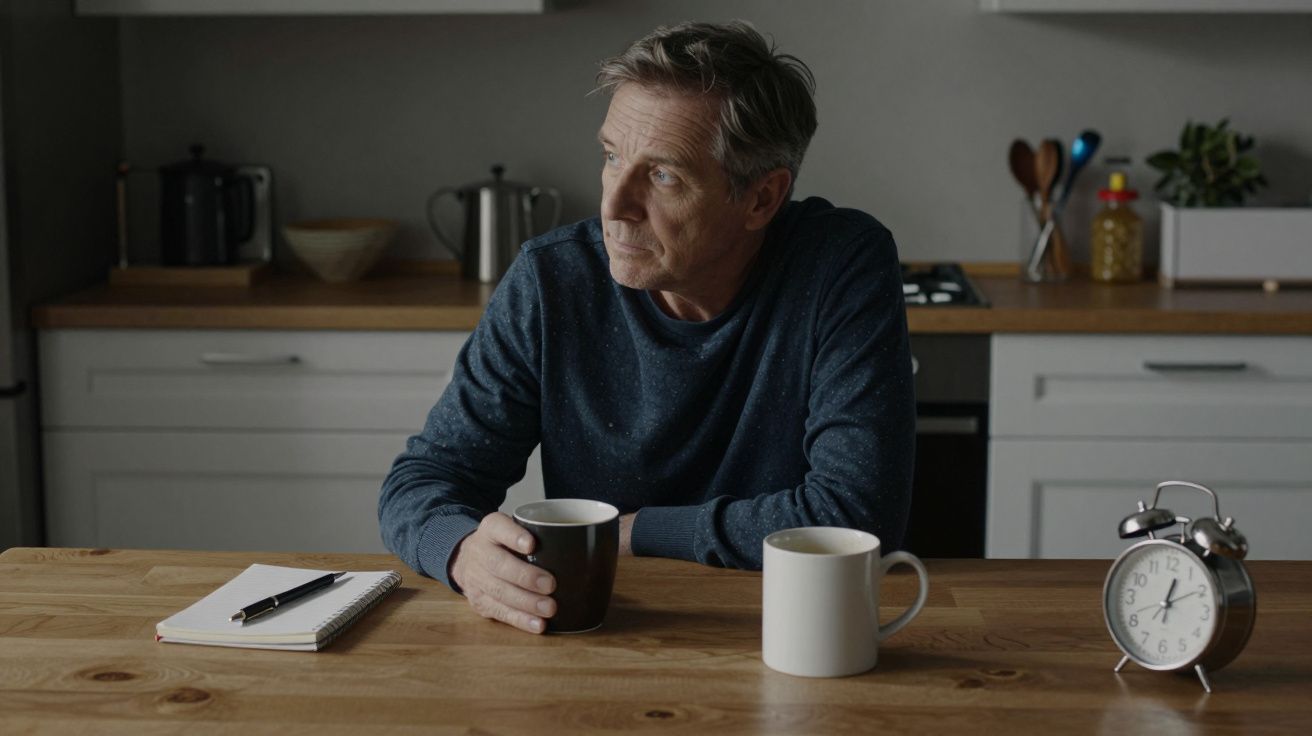
You lie there in the dark, staring at the ceiling.
The clock says 3:07am. Again.
You do the usual inventory. Hormones? Stress? Bladder? The neighbour’s cat? You promise yourself you’ll go to bed earlier tomorrow, you’ll buy magnesium, you’ll try that sleep app someone mentioned. Yet night after night, your eyes ping open in the early hours as if something has set an internal alarm you never asked for.
It feels random-until you notice a quieter pattern hiding in your day.
Not in the evening, but around 2–4pm, when you reach for “just one” pick‑me‑up.
For a surprising number of people over 50, sleep doctors say that innocent afternoon coffee (or strong tea, or fizzy drink) is still whispering in the brain long after you’ve washed up the dinner dishes. By 3am, it’s often the only one still wide awake.
When 3am becomes your new alarm clock
The pattern usually sneaks up slowly.
At first, you just wake a bit earlier than usual. You check your phone, roll over, and mostly get away with it. Then the awake stretches get longer. You start dreading the moment your eyes open and you know-before you even look-that it’s the middle of the night.
You try to be reasonable: maybe it’s age, or menopause, or work worries. All of those can play a part. But the signature of the “caffeine wake‑up” is oddly consistent:
- You fall asleep reasonably quickly.
- You wake around 2–4am, mind suddenly alert.
- Getting back to sleep feels like pushing a boulder uphill.
Lie there long enough and your brain starts telling stories. You’re broken. This is what “old” feels like. You’ll be exhausted forever. In reality, your nervous system is simply responding to a chemical that hasn’t quite left the building.
Most of us think of coffee-or tea or cola-as a short, sharp boost. You drink it, you perk up, you crash. What we rarely see is the long, slow tail that can reach deep into the night, especially after 50.
The afternoon drink that doesn’t clock off when you do
The villain here isn’t some obscure toxin. It’s caffeine.
In a flat white, in a builder’s tea, in that “just a little” square of dark chocolate, in the can of cola you swear you only drink on busy days.
Caffeine works by blocking adenosine, a brain chemical that helps you feel sleepy. Think of adenosine as a gentle hand on your shoulder guiding you towards bed. Caffeine slips between you and that hand, saying, “Not yet.” The trouble is, it keeps saying “not yet” for hours.
In most adults, the half‑life of caffeine is around five to seven hours. That means:
- A 3pm coffee can still leave half its caffeine in your system at 8–10pm.
- By midnight there may still be a quarter left, quietly nudging your brain towards wakefulness instead of deep, continuous sleep.
Sleep doctors see a familiar pattern in clinic: people swear they “only” have caffeine at lunchtime or mid‑afternoon, convinced it can’t be affecting sleep. Then they stop that one drink for a fortnight and their 3am wake‑ups ease or vanish.
It isn’t just about falling asleep. Caffeine is particularly good at:
- Lightening sleep (less deep, restorative sleep).
- Fragmenting the night (more micro‑awakenings you may not remember).
- Making you more sensitive to every small disturbance-traffic, a snore, a hot flush, a racing thought.
By 3am, when your natural sleep drive has eased off a little, the residue of that afternoon drink can be enough to tip you from “just asleep” to “fully awake, wondering why.”
Why it hits harder after 50
Here’s where age quietly shifts the odds.
As we get older, several changes pile up:
Slower caffeine clearance.
Your liver doesn’t process caffeine quite as briskly as it used to. The same drink can hang around longer and at higher levels.Lighter, more fragile sleep.
Deep sleep tends to shrink with age. You spend more time in lighter stages where you’re easier to wake and more likely to remember waking.Hormonal changes.
Menopause, perimenopause and andropause can all disrupt temperature regulation, mood and sleep architecture. Add caffeine and you amplify that fragility.Medication interactions.
Some common medicines (for blood pressure, acid reflux, depression, asthma) can either slow caffeine breakdown or already nudge the nervous system. The combination can be more stimulating than you think.
The net effect: a coffee that felt harmless at 35 can behave like an espresso martini at 55.
To complicate things, caffeine doesn’t always make older adults feel wired in the same obvious way. You may not get jittery or overstimulated. Instead, it quietly trims minutes off your deep sleep, nudges you awake in the night, and leaves you feeling foggy in the morning despite “technically” getting enough hours in bed.
Soyons honnêtes : personne ne fait vraiment ça tous les jours, analyser tout ce qu’il boit et mange à 3pm en pensant à 3am. Yet that’s exactly the kind of backward detective work good sleep often requires after 50.
The usual suspects (it’s not just coffee)
When sleep doctors say “caffeine”, they rarely mean just espresso. The stealth sources catch people out:
- Strong black tea or green tea (“It’s only tea…”).
- “Diet” or regular cola and energy drinks.
- Hot chocolate and dark chocolate (especially in the evening).
- Certain painkillers that include caffeine for faster action.
- “Decaf” that’s not quite as decaffeinated as the label suggests.
Individually, each might seem modest. Layered across a day-morning mug, lunch‑time top‑up, 3pm “treat”-they can keep a steady trickle of caffeine in your bloodstream right through the night.
And the timing matters. A single 7am coffee is very different, physiologically, from a 3pm refill.
A two‑week experiment most sleep doctors wish you’d try
The good news: you don’t have to guess. You can run your own small, low‑risk experiment.
For just 14 days:
Set a caffeine cut‑off time.
Aim for no caffeine after 12–1pm. For some people over 50, even 11am is better.Count all sources, not just coffee.
Swap afternoon tea, cola and chocolate for:- Herbal teas (rooibos, camomile, peppermint).
- Decaf versions from a brand that tests low in caffeine.
- A small snack that isn’t chocolate if you crave “something” at 3pm.
Stay boringly consistent.
Don’t change twenty other things at once. Try to keep bedtime, exercise and alcohol roughly the same, so you can actually see what caffeine does.Watch the 3am window.
You’re not just tracking how fast you fall asleep. Pay attention to:- How often you wake between 2–4am.
- How long it takes to drop off again.
- How restored you feel at 7–8am.
Then bring it back-carefully.
If nights improve, try re‑introducing a small afternoon caffeine on one or two days and see if the 3am wake‑ups return. Many people are startled by how clear the pattern suddenly looks.
“The day I moved my last coffee from 3pm to 10am, I didn’t sleep like a teenager again. But I stopped staring at the ceiling at 3:24am every night. It felt like I’d been given my mornings back.”
If it’s not (only) the coffee
Caffeine is a common trigger, but it’s not the only one. If you’ve tamed your afternoon drinks and you’re still repeatedly awake in the small hours, it’s worth scanning for other culprits:
Alcohol.
That evening glass of wine can help you nod off, then rebound in the early hours as levels fall, lightening sleep and pushing you awake.Blood sugar swings.
Very early dinners, sugary snacks late at night or skipped meals can all set you up for 3am dips that feel like anxiety or restlessness.Night sweats and temperature.
Especially around menopause, small temperature spikes can jolt you out of lighter sleep. Cooling the bedroom and breathable bedding help more than they sound.Racing thoughts.
Work worries, family issues, long mental to‑do lists-3am is when they love to visit. A notebook by the bed and a simple wind‑down routine before sleep can take the edge off.Medical conditions.
Sleep apnoea, restless legs, overactive bladder, thyroid problems and mood disorders are all common after 50 and all disturb sleep. Persistent 3am waking plus loud snoring, gasping, leg discomfort or low mood is a good reason to talk to your GP rather than suffer in silence.
Caffeine isn’t responsible for every bad night. But it is one of the easiest levers to test-and one many people overlook because the “crime” happens in daylight.
Turning sleep from a mystery into a simple system
You don’t need to live like a monk to sleep better in your fifties and beyond. What helps most is a few clear rules that work even on messy, real‑life days:
- One or two caffeinated drinks in the morning only.
- A calm, predictable wind‑down hour before bed (lights down, screens dimmer, no heavy emails).
- A bedroom that’s dark, cool and quiet.
- Getting up at roughly the same time every day, even after a poor night.
Then, when 3am wake‑ups do appear, you have a short checklist instead of a spiral of self‑blame: “Did I break my caffeine rule? Did I drink more than usual? Has something else changed?”
Over a few weeks, what felt like a mysterious punishment of age starts to look more like a set of levers you can actually move.
| Key point | Detail | Why it matters for you |
|---|---|---|
| Caffeine lasts longer than you think | A 3pm drink can still be in your system at midnight and beyond | Explains why you wake at 3am even if you “sleep fine” at first |
| Over‑50s clear caffeine more slowly | Age, hormones and medicines all slow breakdown | The same habits that were harmless at 30 can disrupt sleep at 50+ |
| A short experiment beats guessing | Two weeks without afternoon caffeine is a simple test | Lets you see if 3am waking is linked to that “harmless” drink |
FAQ:
- Is it really necessary to stop caffeine after midday?
Not for everyone, but for many people over 50 with stubborn 3am waking, a strict midday cut‑off is often what finally shifts the pattern. You can always relax it slightly once you understand your own sensitivity.- Does decaf count as caffeine‑free?
Decaf still contains small amounts of caffeine, but usually far less than regular coffee. Most people can drink decaf in the afternoon without trouble, though if you’re very sensitive, keep it to earlier in the day.- What if I need something to stay awake at work?
Try moving your main caffeine to earlier in the morning, using light, a short brisk walk, stretching or a glass of water to break up the afternoon slump instead of another coffee or tea. Better sleep at night usually makes that slump less brutal.- How long until my sleep improves after cutting back?
Some people notice a difference within a few days; for others it takes 1–2 weeks for the body to adjust and for sleep debt to ease. Give your experiment a full fortnight before you judge it.- When should I see a doctor about 3am waking?
If you’ve tried simple changes (including moving caffeine earlier) for a few weeks and still wake exhausted most nights-or if you snore loudly, gasp in your sleep, feel very low or very anxious-speak to your GP. There may be a treatable medical cause beyond caffeine.





Comments (0)
No comments yet. Be the first to comment!
Leave a Comment