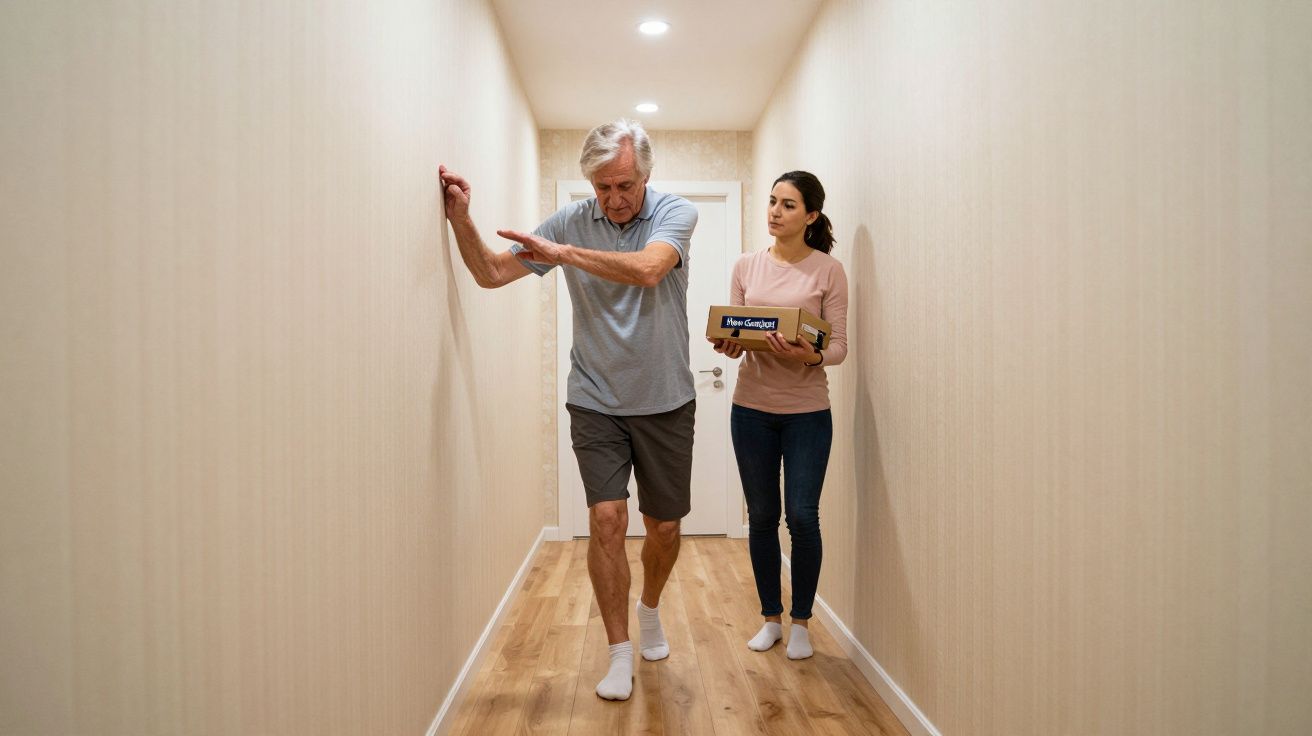
It is 10:07 on a Tuesday in a narrow upstairs hallway in Leeds, and Arthur is standing still, staring at the wallpaper.
His daughter has bought him a smartwatch that detects falls, gripped about walking sticks, and bookmarked half the internet’s “best anti‑fall gadgets for seniors”. The box from the latest device is still open on the dining table. The thing that is actually making him wobble a little less each month costs nothing and is happening right now, in his socks, between two modest magnolia walls.
“Ten slow steps, heel to toe,” says the physiotherapist beside him, one hand hovering near his elbow, not quite touching. Arthur rolls his eyes, but he walks. His heel kisses his toes, shoes lined up along an imaginary tightrope. His fingertips skim the wallpaper for reassurance.
It looks almost childish. It also happens to be one of the handful of exercises gerontologists keep repeating in conferences, clinics and care homes, because the numbers are stubborn: older adults who regularly practise this kind of simple balance drill cut their fall risk far more than people who only buy equipment and hope for the best.
The surprising part is where the experts want you to do it: not in a fancy gym, but in the plainest, most predictable, slightly boring place in the house.
Your hallway.
The corridor “tightrope” most people never use
Ask geriatricians and physios what single home exercise they wish every person over 70 would adopt, and a version of the same answer comes back: a supported “line walk” in a hallway or along a kitchen counter.
Different clinics give it different names-tandem walk, heel‑to‑toe walk, corridor tightrope-but the principle is the same:
You walk slowly along an imaginary straight line, placing one foot directly in front of the other, while your fingertips can safely reach a wall or sturdy surface on either side.
The hallway is not chosen by accident. It offers exactly what older bodies need to relearn balance without panic:
- Straight, predictable flooring you know well.
- Walls close enough for light support if you sway.
- Good lighting and usually no rugs or trailing cables (or at least, there should not be).
In studies and fall‑prevention programmes, regular tandem walking-especially when combined with simple strength work-has reduced falls and near‑falls more than many popular gadgets on their own. Alarms and hip protectors help when you hit the ground. This kind of exercise quietly trains you not to hit it in the first place.
Why this one move beats most gadgets
Falls in later life are rarely about one dramatic trip. They creep in through slower reactions, weaker ankles, stiff hips, poorer sensation in the feet, and a brain that has quietly lost practice at dealing with tiny wobbles.
The heel‑to‑toe hallway walk targets several of those problems at once:
- Balance and “righting” reactions: Walking on a narrow base forces your body to make constant micro‑adjustments, just like on an uneven pavement or crowded bus.
- Ankles and hips: The small muscles around your ankles and hips, which act as stabilisers, have to switch back on instead of letting a walking stick do all the work.
- Proprioception (your internal sense of where your body is): Each precise foot placement feeds your nervous system information it has not used properly for years.
- Confidence: Perhaps the most underrated effect. The hallway offers a safe place to wobble and recover, on purpose, instead of freezing every time the ground feels uncertain.
Compare that with a device on your wrist that calls an ambulance after you fall, or a shiny walking frame you only use outside. Those have their place. Yet, as one gerontologist in a London clinic put it during a group session:
“If I had to choose between the latest sensor and five minutes of good hallway balance work most days, I’d pick the hallway. The hallway does not run out of batteries.”
Of course, nobody is suggesting you throw helpful equipment away. The point is different: without regular balance training, gadgets are seatbelts in a car you never service.
How to do the “hallway line” safely
Before you start, two ground rules: you should feel challenged, not terrified. And you should always be able to catch yourself with your hands within one small step.
Set up your space
- Choose a well‑lit hallway or corridor with clear, flat flooring.
- Remove loose rugs, shoes, pet bowls and anything you could trip over.
- If your hallway is very narrow, that is fine-being able to touch both walls is a bonus.
- Wear firm, flat shoes with a non‑slip sole, or go barefoot if your podiatrist says that is safe for you.
Basic version: fingertip‑supported heel‑to‑toe walk
- Stand at one end of the hallway, facing down the corridor.
- Lift your chest, look ahead at eye level (not at your feet), and lightly rest your fingertips on the wall to your right or left.
- Place one foot in front of the other so that the heel of the front foot touches the toes of the back foot, as if you are walking on a line.
- Take 10 slow, controlled steps, heel to toe each time. Move your fingers along the wall as you go.
- Breathe normally. If you lose balance, widen your stance slightly or put your hand flat on the wall, then reset.
- At the end of the corridor, turn around in your normal walking stance, and walk back the same way.
Start with 1–2 trips up and down, once a day. Most people can add a second short session (morning and late afternoon) within a couple of weeks.
When it feels too easy
If you can walk heel‑to‑toe the length of your hallway and back with just fingertip support and no major wobbles on most days, you can progress gradually:
- Use only one finger on the wall instead of all four.
- Hold the wall for every second or third step, not continuously.
- Place your feet heel‑to‑toe over a strip of tape on the floor to keep the line narrow.
- Gently turn your head to look left and right every few steps while keeping your feet on the line.
You do not need circus tricks. Small increases in challenge, repeated most days, are what rebuild your balance.
When it feels too hard
If heel‑to‑toe feels frightening or you have already had several serious falls:
- Start with a “narrow stance” walk: feet closer together than usual, but not touching.
- Keep one full hand on the wall at all times.
- Try only 5 steps, then rest.
- Have a family member stand beside you, or position a sturdy chair at the end of the corridor so you can sit if you feel unsteady.
If even this feels unsafe, speak to your GP or physiotherapist; they can adapt the exercise or suggest supported alternatives.
Fitting it into real life (and sticking with it)
The people who benefit most from this kind of balance work are not the ones with the perfect technique. They are the ones who manage to do it often enough that it becomes as normal as brushing their teeth.
A simple framework many geriatric clinics use:
- Frequency: Aim for most days of the week (5–7).
- Dose: 2–4 “corridor trips” (up and back) per session.
- Time: It usually totals 3–6 minutes, including turning and resting.
Common tricks to make it stick:
- Link it to a habit you already have:
- After you make your morning tea.
- Each time you walk back from the bathroom.
- While you wait for the microwave or kettle.
- After you make your morning tea.
- Keep a quiet mental score: “I’ve done my hallway today” matters more than counting exact steps.
- Involve someone else. Couples often do it together, taking turns as the “spotter”.
As one 79‑year‑old in a community class said, laughing, “I call it my corridor commute. I do it before I sit down with the paper, otherwise I forget and never move again.”
When not to do it alone
Balance training is powerful, but it is not a dare. There are moments when you should get professional advice before you start practising in the hallway unsupervised:
- You have had more than one fall in the past three months.
- You feel dizzy or light‑headed when you stand up.
- You have severe osteoporosis, very fragile bones, or a recent fracture.
- You have significant vision loss or sudden changes in your sight.
- You have numbness in your feet that makes it hard to feel the floor.
A GP, geriatrician or physiotherapist can check for underlying causes and tailor the complexity of the exercise to you. For some people, the first step is not the line walk, but simply practising standing up and sitting down safely, or holding onto a kitchen counter while shifting weight from one foot to the other.
If in doubt, keep the challenge modest and the safety margin generous.
What this hallway ritual really changes
Seen from the outside, the corridor balance walk is almost nothing: a few careful steps between walls you have walked past a thousand times.
Yet over months, it quietly alters things that matter more than a new gadget ever will:
- How quickly you recover from a trip on the pavement.
- Whether a wobble on the bus becomes a story or an ambulance call.
- Whether you avoid activities you love because “my balance is not what it was”, or rebuild enough trust in your body to keep going.
Step back for a second and your hallway begins to look like more than a strip of carpet. It becomes a small, stubborn claim to independence.
Arthur, back in Leeds, still owns the smartwatch. His daughter still reads reviews of clever devices. The physiotherapist still turns up on Tuesdays, coffee in hand. But the habit that has quietly given him the courage to go down the front steps alone again is something else: ten slow, deliberate steps on an imaginary line, between two ordinary walls, most days of the week.
That is the kind of technology his 80‑year‑old body understands.
| Key point | Detail |
|---|---|
| Hallway heel‑to‑toe walk | Simple, supported “tightrope” walk that challenges balance safely |
| Why it works | Trains ankles, hips, balance reactions, confidence and body awareness |
| How often | Most days, 2–4 trips up and down the corridor, taking 3–6 minutes total |
FAQ:
- Do I need a doctor’s permission to start this exercise? If you are generally well, have not had recent serious falls and do not feel dizzy when you stand, you can usually start with the easiest, well‑supported version. If you have multiple recent falls, severe osteoporosis, chest pain, sudden breathlessness or major balance or vision problems, speak to your GP or physiotherapist first.
- Will this replace my walking stick or frame? Not necessarily. Many older adults will always benefit from a stick or frame outdoors. The aim of the hallway walk is not to throw aids away, but to keep the rest of your balance system as sharp as possible so that you rely on them wisely, not completely.
- How long before I notice a difference? People often report feeling a bit steadier and more confident within 4–6 weeks of regular practice, though measurable changes in strength and balance can take longer. The key is consistency over months, not perfection in any one session.
- What if I do not have a hallway? You can adapt the exercise along the back of a sofa, beside a bed, or along a sturdy kitchen worktop, as long as you have a clear, straight path and something solid to touch with your hand. Keep the floor uncluttered and the lighting good.
- Are there gadgets that actually help with balance training? Some devices, like wobble boards or balance pads, can be useful under professional guidance, but they are not essential. For most people over 70, regular, simple drills in familiar spaces-hallway walks, sit‑to‑stands from a chair, and standing on one leg while holding a support-provide more reliable benefits than complex equipment used only once in a while.


Comments (0)
No comments yet. Be the first to comment!
Leave a Comment