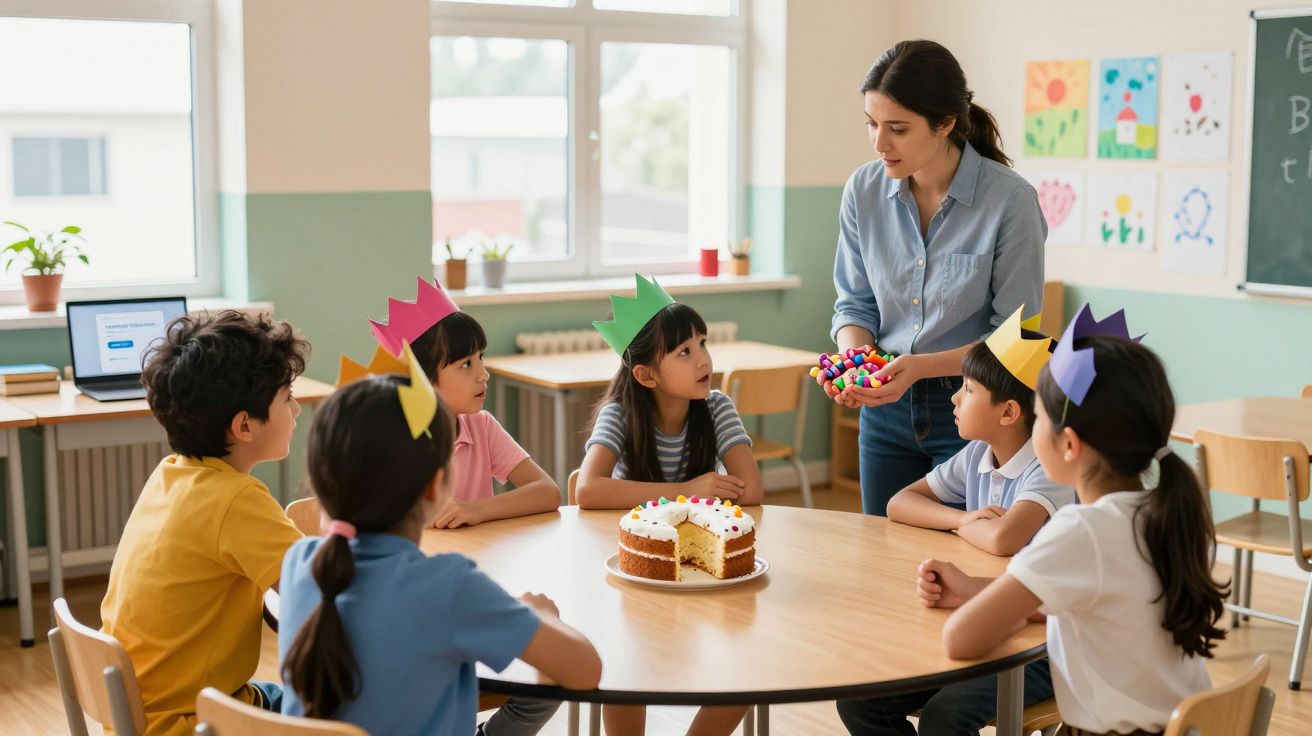
At 3pm the classroom was already humming. Thirty children in paper crowns, one slightly lopsided Victoria sponge on the side, a teaching assistant quietly counting out mini packets of Haribo. It was the familiar end‑of‑day ritual: quick song, one candle, a rustle of sweets into eager hands.
Then the email landed in parents’ inboxes.
“From next term, we will no longer be allowing food treats, including sweets and cakes, to be brought into school for birthdays.”
Within minutes the class WhatsApp lit up. Some parents typed clapping emojis and “About time”. Others fired back with “Can we not have anything nice anymore?” and a link to a long Facebook rant about “childhood being cancelled”.
On the surface it is about jelly babies and cupcakes. Underneath, it is about health, fairness, workload, and who gets to decide what childhood looks like between 9am and 3pm.
The quiet rule that would change birthday mornings
Birthday sweets in primary schools sit in a strange space: no one wrote them into policy, but they’ve become an expectation. In many UK classrooms it works like this: a child turns seven, a parent sends in a bag of wrapped sweets, the teacher hands them out at home time with a breezy “Ask your grown‑up before you eat it”.
The new wave of proposals would stop that altogether. Versions of the rule vary, but they tend to say:
- No cakes, sweets or edible treats to be sent in for birthdays.
- Staff should not distribute food brought from home to the whole class.
- Birthdays can still be marked in non‑food ways: a song, a sticker, a special job for the day.
To some, that sounds sensible and overdue. To others, it feels like yet another small joy tidied away in the name of “health and safety”. The tension is not really about a single jelly bean. It’s about what the school day is for.
Why schools are turning away from sugar
When you ask headteachers why they’re considering a ban, the word “sugar” is rarely the only thing that comes up. It is part of a much bigger picture they see, child after child, every year.
Health concerns that don’t vanish at the school gate
Teachers and school nurses are blunt: they are seeing more children with obesity, tooth decay and early signs of Type 2 diabetes. NHS data show roughly a quarter of children in England leave primary school living with obesity. Cavity‑ridden teeth are now one of the leading reasons children are admitted to hospital.
A single birthday sweet is not the cause. But in some classes there can be two or three birthdays a week. Add in bake sales, end‑of‑term parties, ice‑cream vans at the gate, and sweets stop feeling like “occasional” treats.
Schools are also expected to model the government’s healthy eating guidance. It can feel odd teaching Year 4 about sugar and dental health in the morning, then handing out chewy sweets at 3.20pm because it is Josh’s birthday.
Allergies and medical needs in a crowded classroom
Then there are the children for whom “just one Haribo” is not a casual offer.
- Pupils with severe nut, milk or egg allergies.
- Children with coeliac disease or medically managed diets.
- Those with diabetes, where unplanned sugar causes problems later.
Food labels are tricky even for adults in a quiet kitchen. In a classroom of 30, with home‑brought bags in multiple languages, the margin for error shrinks. Many teachers have stories of last‑minute panics:
A child in tears because the treat “might not be safe”.
A teacher trying to Google “is this gelatine halal?” while coats are going on.
One child sitting empty‑handed with a rice cake while everyone else clutches a cupcake.
For schools increasingly focused on inclusion, that moment – the one child who can’t join in – has started to feel less like a tiny inconvenience and more like a design flaw.
It’s not just about sugar: the fairness problem
Behind the health arguments sits something quieter but equally raw: fairness. Birthday treats expose fault lines that schools spend a lot of time trying to smooth over.
Who can afford a bag for 30?
In some classes, a “proper” birthday offering has drifted from a bag of supermarket sweets to:
- Cupcakes with personalised toppers.
- Party bags with toys and stationery.
- Branded, “free‑from” alternatives for those with allergies.
None of that is in any handbook. It is just how expectations creep. For families watching every pound, the idea that you “ought to” provide something for the entire class can feel like yet another bill attached to simply having a child at school.
Most primary teachers can name the children who never bring treats. They can also tell you how those children sometimes look on as others wheel in boxes of cupcakes and balloons, and how hard staff work to make sure non‑treat days still feel special. A blanket “no food treats” rule is, in part, an attempt to level that playing field.
Religion, culture and the politics of a marshmallow
Food is rarely just food. It is also faith, culture and family rules. In a typical UK class you might have:
- Muslim families avoiding gelatine or certain colourings.
- Hindu and Sikh children whose parents prefer vegetarian‑only treats.
- Christian and secular families who are relaxed about almost anything.
- Parents who keep ultra‑processed food to a minimum.
One parent’s harmless marshmallow is another parent’s “absolutely not”. When a school allows birthday sweets, it is effectively asking staff to navigate all those lines, in real time, at the classroom door.
A ban can be read as the school quietly saying: we cannot be the referee for thirty different food philosophies every afternoon.
What parents who hate the idea are really afraid of
Talk to parents who are furious about the proposed bans, and sugar is not their only concern either. You hear other, more emotional things underneath.
Losing the “little big” moments
For many families, the classroom birthday is part of a wider ritual. The child wakes up buzzing, puts on a favourite outfit, carries a bag of sweets in proudly, savours the “happy birthday” in front of their friends. A small ceremony, but for some children, the highlight of the school year.
Remove the sweets, and there is a fear that the moment will flatten. Parents who cannot afford parties at soft‑play centres sometimes see the class treat as the only communal celebration their child will get. Take it away, and it feels like another door closed.
There is also the work that goes unseen: the parent who stayed up at midnight frosting 30 fairy cakes after a late shift, not because the school demanded it, but because it made their child glow. To them, a ban feels like being told that effort was misguided, or worse, harmful.
The creeping sense of “what next?”
Then there is the mood music of modern parenting: the sense that rules keep stacking up. No sweets in packed lunches. No squash in water bottles. No home‑made cakes at bake sales without ingredient lists. Now, perhaps, no birthday treats.
For some, the proposed bans hit a deeper anxiety that childhood is being sanded down in the name of health metrics and risk avoidance. They worry that children will grow up with a strange relationship to food if everything sweet is seen as suspect, especially in school – a place that once meant rectangle sponge and pink custard on Fridays.
Underneath, there is a more personal question: if schools say no to sweets, are they quietly saying that parents cannot be trusted?
The arguments in one glance
Here is how the debate often looks when you strip away the WhatsApp drama:
| Issue | Why supporters back a ban | What critics worry about |
|---|---|---|
| Health | Less sugar, fewer cavities; schools model guidance | Over‑focusing on tiny treats, ignoring bigger diet picture |
| Inclusion | Fewer allergy scares; no one left out | One blanket rule punishes children who can safely join in |
| Fairness | Removes unspoken pressure to provide for 30 kids | Takes away the only party some children get |
| Workload | Staff not stuck label‑checking at the door | Yet another policy for teachers to police |
| Culture | Aligns school with healthy, calm environment | Chips away at joyful traditions and spontaneity |
Both sides are, in their own way, trying to protect children – just from different harms.
What might a middle ground look like?
Not every school that ditches birthday sweets does so in a joyless way. Some are quietly experimenting with alternatives that try to keep the excitement without the sugar and stress.
A few of the options being tested:
Birthday privileges
The birthday child chooses the first story, sits on a special cushion, or is “helper” for the day. Simple, free, and still feels like a big deal when you are seven.Non‑food tokens
A birthday badge, a class card signed by everyone, or a special pencil kept in a “birthday box” for them to take home.The birthday book
Families who can afford it donate a book to the class library with a nameplate inside: “Donated for Maya’s 8th birthday”. The child gets to show it off at story time.Party in a lesson, not in a packet
Once a half‑term, the class has a joint “unbirthday” celebration – music during tidy‑up, extra play, perhaps a shared craft. Teachers mark all the birthdays from that period at once, without daily sugar.
Middle ground is not perfect. Some children will still ask, wistfully, why they no longer get a lolly to take home. Some parents will still feel the loss more keenly than others. But it shifts the focus from “What can I give the class?” to “How can the class celebrate together?”
What this is really about: the role of school
At heart, the birthday sweets debate is less about Haribo and more about boundaries.
- Is school primarily a place for learning, where health and equality are prioritised, even over small rituals?
- Or is it a mini‑community, where personal traditions and home cultures can spill over the threshold – unpolished, sometimes sugary, but deeply human?
Most headteachers know that whatever decision they make will please some and anger others. They also know that lines, once drawn, tend to hold for years. The real work lies not just in writing the policy, but in how it is explained.
The schools that navigate this best tend to:
- Be clear and consistent, so parents know what to expect.
- Name all the reasons – health, allergies, fairness, workload – not just “sugar”.
- Offer concrete, cheerful alternatives, not just a list of “no”.
- Acknowledge the feelings involved, including their own staff’s.
The sweets may be small, but the questions they raise are not. They touch on who gets to shape a child’s day, whose values set the tone, and how we balance joy with care.
For now, many classrooms still end with the familiar rustle of birthday treats. Over the next few years, more schools may quietly trade that rustle for a song, a badge, or a special story instead. Whether that feels like a loss or a sensible shift depends, mostly, on what you think school is for.
FAQ:
- Can schools legally ban birthday sweets?
Yes. Schools in the UK set their own policies on what can be brought onto site, within broad government guidance on health and safety. A birthday‑treat rule usually sits alongside wider food and behaviour policies.- Does one sweet a week really affect children’s health?
On its own, probably not. Supporters argue that in practice it can add up to many more, and that schools should model habits they teach. Critics say the focus should be on overall diet and exercise, not occasional class rituals.- What if I strongly disagree with my child’s school policy?
You can raise concerns with the class teacher, headteacher or governors, ideally focusing on how the policy affects your child rather than attacking staff personally. Ultimately, though, schools are not obliged to allow food treats.- Can I send in non‑food gifts instead?
Some schools allow small items like stickers or pencils; others ask for no individual gifts at all to avoid cost and waste. Check your school’s specific guidance before buying anything.- How can I make my child’s birthday feel special if sweets at school are banned?
Many families shift the focus to home: a special breakfast, walking to school with a birthday badge, choosing the evening meal, or planning a low‑cost weekend treat. You can also work with teachers on allowed in‑class rituals, like sharing a favourite story or bringing in a baby photo for “guess who” time.



Comments (0)
No comments yet. Be the first to comment!
Leave a Comment