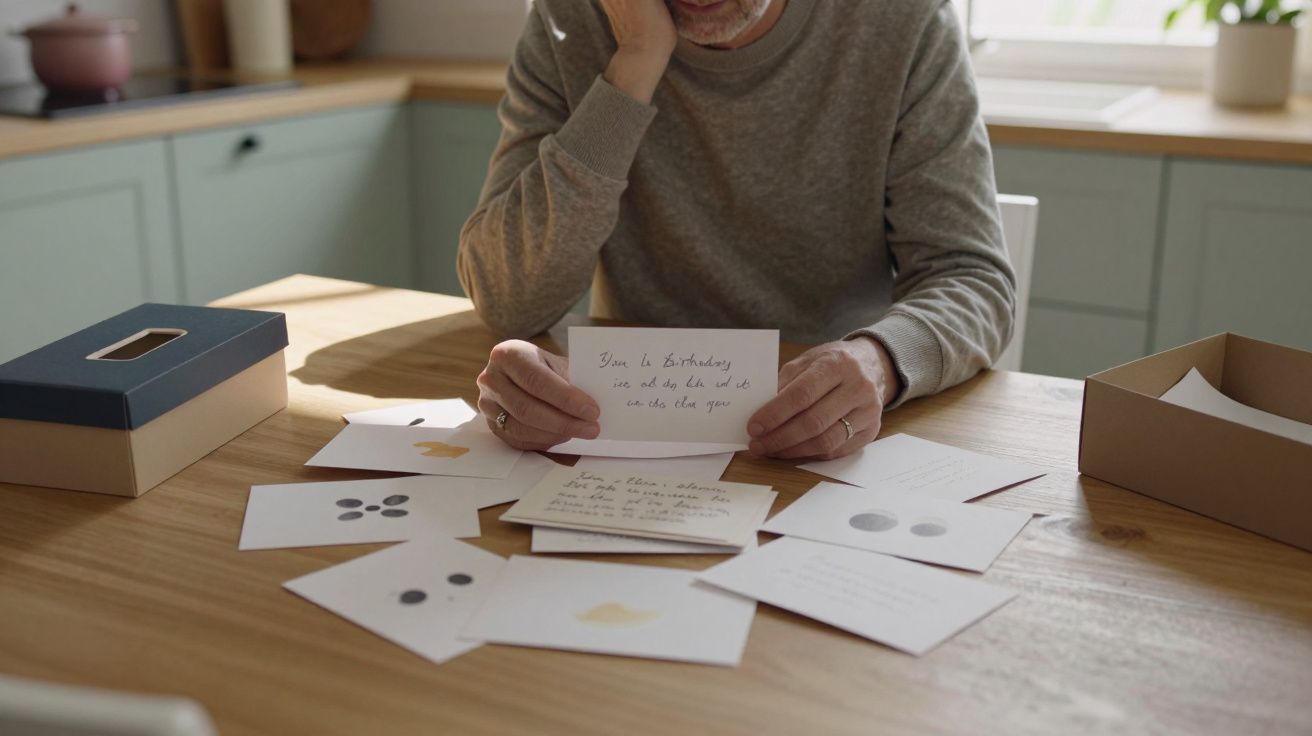
Rain had pushed everyone into the kitchen. The cake was leaning, the candles were too many, and someone had forgotten to buy matches. Later, after the washing-up and the whatsapp photos and the last bit of buttercream straight from the knife, you were left with the thing that never goes on Instagram: a small pile of birthday cards, damp with fingerprints and prosecco rings, quietly asking to be kept forever.
You told yourself you’d “sort them later”. Instead, they migrated: from worktop to sideboard, from drawer to shoebox, from shoebox to loft. Ten years on, you opened a lid and felt your throat tighten at a familiar handwriting you will never see again. Your first thought wasn’t joy. It was: I can’t throw these away. What kind of person would that make me?
Therapists will tell you that this stuck feeling around old cards isn’t about clutter management. It’s about grief, loyalty, identity, and the uneasy sense that your memories might vanish if the paper does. The good news: you can clear space without betraying anyone – including your past self. You just need to understand what those folded bits of card are really doing for you.
What those old birthday cards are quietly doing for you
On the surface, they’re cheap card stock and glitter that never quite vacuums up. Psychologically, they’re doing several heavy jobs at once.
For many people, birthday cards act as proof of being loved. If you grew up with emotional distance, chaos, or on-and-off relationships, seeing “To my wonderful daughter” in your mum’s handwriting can feel like a legal document that it really did happen. Throwing it away feels like ripping up evidence.
Cards also work as portable memorials. When the person who wrote them has died, or the relationship has ended, that last “Lots of love, Dad x” becomes a place your grief goes to sit. The box starts to function like a tiny archive of people you’ve lost, kept in a form that’s easy to access and hard to challenge.
Then there’s identity. A decade of cards from old jobs, flatshares, and friendships map out the story you tell yourself about who you are: fun, reliable, the one who always organises the night out. Therapists often hear clients say, “If I get rid of these, will I still feel like that person?” You’re not only hoarding paper; you’re curating a self.
One more layer: for some, cards soothe a deep scarcity fear. If affection felt rare or unpredictable, every written “love you” carries the weight of “what if this is the last time?” The pile grows because you’re quietly stockpiling warmth for a future you don’t entirely trust.
Why guilt shows up the moment you pick up the recycling bag
Guilt around decluttering sentimental things rarely comes from laziness. It comes from invisible rules you’ve absorbed over years.
Some are family rules: in many homes, you “don’t waste nice things” or “keep anything from Nan”. Decluttering starts to feel like breaking an unspoken contract with your ancestors. For anyone from a background of war, migration or poverty, discarding usable items can carry extra weight: you might be the first generation with the luxury to let go, which can feel disloyal.
There’s also the belief that objects equal respect. If you recycle a card from a friend who tried hard with the message, does that mean you didn’t value them enough? Therapists often hear a quiet panic under this: “If they knew I’d thrown it out, they’d be hurt,” even if the sender themselves hasn’t thought about that card since posting it.
Then there’s magical thinking, the part of the brain that links card-keeping with safety. “If I throw away Dad’s cards, something bad will happen,” or “If I keep them, the relationship will somehow stay safe.” Logically, you know that isn’t how the world works. Emotionally, the ritual of keeping feels like a spell you’re afraid to break.
Finally, guilt may actually be unprocessed sadness in disguise. It’s often less painful to say “I feel awful throwing this out” than to say “It hurts that this person is gone” or “I miss the version of me who got this card.” When you name the real emotion, the stuckness often eases.
A therapist-style way to declutter birthday cards
Treat this less like a tidying task and more like a short, gentle therapy session you’re guiding yourself through. The aim isn’t a perfectly minimal home. It’s to make conscious choices about what you keep.
1. Say what this really is
Before you touch the box, take 30 seconds and name it out loud or in a notebook.
- “This isn’t a pile of paper; it’s my history with my family.”
- “These cards hold my grief for Mum.”
- “I’m scared that if I let go of them, I’ll forget who I was.”
It may feel a bit awkward, but therapists use this kind of naming because it calms the nervous system. You’re reminding your brain that you’re dealing with feelings, not an emergency.
2. Set a gentle limit – and stick to it
Boundaries make emotional decisions easier. Choose a container – a shoebox, a folder, one small storage basket – and decide: “All my saved birthday cards will live in here. If it doesn’t fit, it doesn’t stay.”
This does two things. It stops the collection quietly multiplying into every cupboard. And it shifts the question from “Do I love this card enough to keep it?” to “Does this deserve one of the limited spaces?” That tiny reframing helps your brain prioritise without shame.
If your current stash is huge, don’t aim to do it all at once. Pick one year, one relationship, or one box at a time. Future you is not giving out medals for finishing in a single afternoon.
3. Sort in three piles, not two
The classic “keep or bin” approach is brutal when emotions are high. Try three categories instead:
- Definite keepers – the ones that make your chest ache or soften in a good way.
- Maybes – anything you hesitate over; don’t overthink it.
- Ready to release – cards with generic printed verses, names you barely recognise, or memories that feel more heavy than warm.
Move quickly. Read the message once; notice how your body feels. If your shoulders drop or you smile, that’s useful data. If you tense up, feel dread, or draw a blank, that’s also data. You’re not judging; you’re observing.
When you’ve filled your chosen container with definite keepers, go back to the maybes and see if anything still needs to be there. Often, 24 hours later, most of the “maybes” quietly turn into “ready to release”.
4. Letting go with a small ritual (so it doesn’t feel like a betrayal)
For most people, the pain isn’t that cards leave. It’s that they leave without being witnessed. A tiny ritual can bridge that gap.
Pick one of these, or invent your own:
- Photograph or scan any message or handwriting that feels important. Create a simple digital folder labelled “Birthday cards I loved”.
- Copy out favourite lines into a notebook or notes app: phrases, jokes, nicknames that still make you feel seen.
- Choose one “representative” card from each person or life phase, and say quietly, “This stands for all the others. Thank you,” before recycling the rest.
- If you’re somewhere safe and it appeals, burn a few cards in a fire pit or metal bowl. Watch the paper change and imagine the love moving from card to body, not disappearing.
It may sound theatrical on paper. In practice, tiny gestures like this satisfy the part of your brain that wants to mark endings properly. The message becomes: I am not throwing you away; I am changing how I keep you.
5. Talk back to the guilt when it shows up
Guilt will likely pop up again the next time you open the bin or see the recycling lorry. Prepare a few sentences in advance, the way a therapist might:
- “The person who wrote this cared about me, not the object.”
- “Their love is in my memories and my behaviour, not in this cardboard.”
- “Keeping everything doesn’t honour them. Choosing with care does.”
- “It’s safe to have a home that works for the person I am now.”
Say them out loud if you can, especially if you feel tight-chested or wobbly. You’re not trying to bully yourself into being fine. You’re offering a calmer narrative than “I’m a terrible person for decluttering.”
How to decide what actually deserves to stay
You’re allowed to have criteria. In fact, clear criteria are kind.
Here are prompts therapists often suggest when clients are drowning in sentiment:
- Keep what is personal. Handwritten messages, in-jokes, notes that refer to a specific shared moment.
- Keep what marks a turning point. The 18th when you finally felt seen, the card from your first birthday as a parent, the year a quiet sibling suddenly wrote a whole paragraph.
- Keep what you’d be genuinely sad to lose, not hypothetically guilty about. If the card disappeared in a small, imaginary fire, would you mostly feel relief? That’s information.
- Keep for the person you are now. Do these words still land, or do they belong to a life you’ve outgrown?
You might find it helpful to jot down your own rules before you start, and put them on top of the box. That way, when future you opens it in five years, they’ll understand why each card earned its place.
A quick guide to what cards often mean – and a kind next step
| If the card is… | It often represents… | A gentle option |
|---|---|---|
| From someone who has died | Ongoing relationship, grief, permission to still feel close | Choose 1–3 favourites, photograph the rest, and store the originals together in a clearly labelled envelope |
| From an ex or old friend you’re no longer in touch with | Proof the good times were real, mixed feelings, unfinished endings | Ask: “Does this help me heal, or keep me stuck?” Keep one that holds a lesson; release the rest |
| Generic from a big group (office, sports team) | Belonging, a chapter of your life story | Keep one from each group or era; let duplicates go after a quick thank you |
You don’t have to follow this table rigidly. It’s a springboard when you’re staring at twenty near-identical “To a great colleague” cards and feeling your energy drain away.
If you just can’t throw anything away (for now)
Sometimes you open the box and the answer is simply: not yet. That’s valid.
In therapy, that’s often treated as information rather than failure. If every card feels unbearably loaded, it may be a sign that your grief or life changes need more attention than a Sunday tidy can give. A few options:
- Time-limit the pause. “I’m not ready now. I’ll revisit this box in six months,” and put a reminder in your calendar.
- Change the context. Instead of spreading cards around the house, consolidate them into one deliberate, labelled container so they feel chosen rather than accidental.
- Bring it to therapy. Literally or metaphorically. Talking through why a particular card hits hard can unlock much more than drawer space.
You’re allowed to go slowly. Decluttering sentimental things is not a moral exam. It’s one way of checking in with how your past and present are getting along.
Making space without erasing your life
At the heart of this is a quiet truth: you are not the archive of every paper that has ever passed through your hands. You’re the person who lived the moments those cards mark.
Keeping fewer cards can actually make the ones you do keep more powerful. You’re curating a small, living collection of love, not guarding a museum out of obligation. The box becomes lighter to carry, both literally and emotionally.
One day, someone else may open that box. What you’re leaving them is not a guilt-inducing mountain of paper, but a carefully chosen handful of glimpses into who you were and who mattered to you. That, in itself, is an act of care – for them, for your memories, and for the space you live in now.
FAQ:
- Is it disrespectful to throw away a card someone took time to write? The respect was in how you received it and how you lived the relationship, not in how long you store the cardboard. You can thank the card, keep the sentiment, and still recycle the object.
- Should I keep every card from someone who’s died? You can, but you don’t have to. Many people find it more comforting to choose a small number of especially meaningful cards and give them a special home, rather than feeling burdened by a large, painful pile.
- What if family members expect me to keep everything? You can acknowledge their values without copying them. Phrases like “I’m keeping the ones that mean the most to me” set a boundary without inviting an argument.
- Is photographing cards “cheating”? Not at all. For some people, a digital archive gives the safety of “it’s not gone” without the physical clutter. If you never look at the photos, that’s data you can use in future declutters.
- How often should I review my saved cards? Once a year – perhaps around your birthday – is enough for most people. Treat it as a small ritual: update what you keep so the collection grows with you, rather than freezing you in old chapters.




Comments (0)
No comments yet. Be the first to comment!
Leave a Comment