You open the freezer for peas and are hit by an avalanche of bread rolls, mystery meat and a tub of ice cream welded to the back wall with frost. Somewhere in there is a bag of chicken you meant to use “soon”. You close the drawer faster than you’d admit to a food safety inspector and decide to deal with it another day.
Most of us treat the freezer like a pause button for food, not a system. But the way you use each drawer quietly affects how safely things freeze, how long they keep their flavour – and how likely you are to unearth something worrying and unlabelled six months from now.
Food safety experts will tell you: it’s not just what you freeze, it’s where you put it. And there’s one drawer in particular that many people are using completely wrong.
Why freezer layout matters more than you think
A freezer feels like a simple yes/no: frozen or not. In reality, it’s more like a slow-motion kitchen – with hot spots, cold spots and traffic patterns every time you pull a drawer open. Cold air sinks, warm air rushes in, and anything near the front or the top warms up a little more with each visit.
Your freezer also has a job beyond “keep stuff hard as a rock”. It needs to:
- Freeze new items quickly so ice crystals stay small and textures survive.
- Keep long‑term residents consistently cold so quality doesn’t quietly slide.
- Stop raw meat juices ever finding their way into foods you’ll eat without cooking.
When drawers are rammed with random bags and boxes, air circulation drops, freezing slows and temperatures fluctuate more than manufacturers intend. That’s how you end up with greyish meat, crumbly bread, frosty veg and, in the worst case, food that hasn’t been held safely cold all the time.
Think of your freezer more like a filing cabinet than a black hole. Each drawer is best at something slightly different.
The drawer most people mis‑use (and what it’s really for)
On many upright freezers, the top compartment is the one that’s quietly special. It’s often labelled “fast freeze” or has the evaporator coils just behind it. That design isn’t an accident: this is the coldest, quickest‑acting part of the freezer.
Its real job is simple: it’s the arrivals lounge.
Fresh food that still contains warmth from your kitchen – raw meat, leftovers, fresh veg, berries, bread – should go here first so it freezes as fast as possible. Quick freezing means:
- Smaller ice crystals (so meat leaks less liquid when thawed).
- Better texture for bread and baked goods.
- Less damage to delicate veg, herbs and berries.
What most of us do instead: turn that top drawer into permanent storage for ice cream, oven chips and a decade of crumpled peas. New, still‑warm food gets shoved wherever it fits, often in a middle or bottom drawer that doesn’t freeze as fast.
A better rule:
“Newly frozen food goes in the fast‑freeze drawer for 24 hours – then moves down.”
Treat that top drawer as short‑stay, high‑priority space. Once things are solid all the way through, you shift them to their long‑term home below.
Where bread, meat and veg really belong
Once you’ve given foods a good fast freeze, placement becomes about safety, quality and how you actually live. Here’s how food safety specialists tend to map it out.
Bread: not just “wherever it fits”
Bread is one of the most commonly frozen foods – and one of the most abused. Left in the wrong spot, it gets freezer burn, absorbs odours and emerges more like cardboard than comfort.
Best home: upper‑middle drawer, towards the back
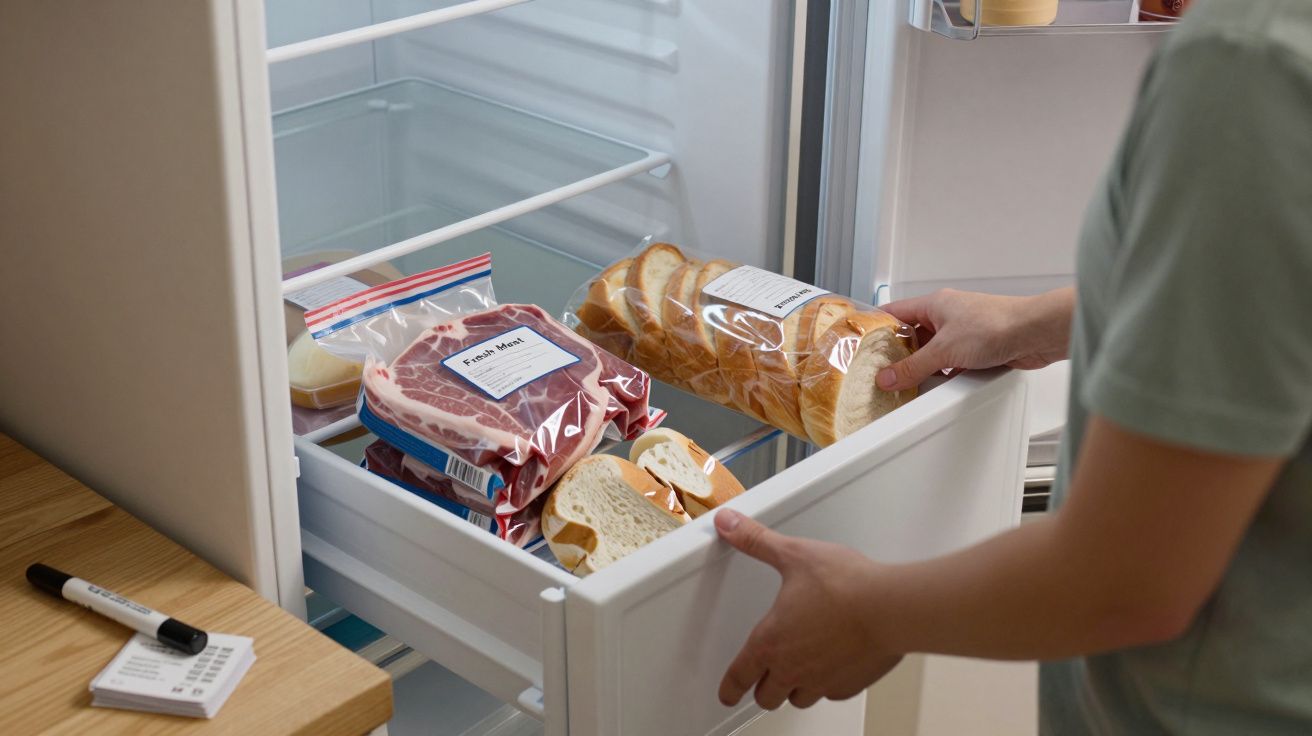
- Keep sliced bread and rolls in the top drawer for the first freeze, then shift them to a middle drawer where temperatures are still cold but access is easy.
- Store in well‑sealed bags with as little air as possible. Double‑bag if your freezer is fragrant with fish or curry.
- Freeze in portions you’ll actually use: half‑loaves, 4‑slice packs, individual rolls.
Aim to use frozen bread within about two to three months for best texture. It’ll often be safe for longer if kept at ‑18°C or below, but quality won’t thank you.
Meat and fish: coldest and most contained
Raw meat and fish are where safety really bites. Freezing pauses bacteria growth, but once you defrost, any contamination issues are back in play.
Best home: lowest drawer, well packaged
- Day 1: put fresh meat and fish in the fast‑freeze/top drawer so they freeze quickly.
- After 24 hours: move them to the bottom drawer and keep that drawer for raw animal products only.
- Use airtight containers or double bags to prevent drips if something softens during a power cut or door‑left‑ajar moment.
- Keep mince and small pieces towards the back and bottom – that’s usually the coldest, most stable zone.
This “raw animal drawer” rule mirrors what food safety teams recommend for fridges: cooked and ready‑to‑eat foods above, raw at the bottom. Even when frozen, it’s a useful protection if anything starts to thaw.
Vegetables and fruit: flexible, but not invincible
Frozen veg feel indestructible, so they’re the first thing to be crammed into odd gaps. But where they sit still affects their texture and nutrients over time.
Best home: middle and lower‑middle drawers
- Pre‑frozen supermarket veg are already fast‑frozen, so they can skip the top drawer and go straight to the middle.
- Keep everyday veg you reach for often – peas, mixed veg, sweetcorn – in a middle drawer you can access easily without rummaging.
- Put bulkier, heavier bags (chips, frozen roast veg, mixed fruit) in a deeper middle or upper‑bottom drawer so they don’t crush softer items.
Delicate veg (spinach, herbs, berries) benefit from that initial night in the fast‑freeze drawer, then can move to the upper‑middle for regular use.
A quick placement guide
| Food type | Best main drawer (after fast freeze) | Why it works there |
|---|---|---|
| Bread & baked goods | Upper‑middle | Easy access, less crushing, steady cold |
| Raw meat & fish | Bottom | Coldest, safest if anything leaks or thaws |
| Veg & fruit | Middle / upper‑bottom | Good cold, good access, less damage |
How to reset your freezer in 15 minutes
You don’t need a full kitchen makeover. A short, slightly ruthless session can transform the way your freezer works for you.
- Turn detective for a moment. Pull out one drawer at a time. Bin anything heavily frosted, unlabelled or obviously ancient. Trust your nose and your notes; “surprise meat” from last summer isn’t a prize.
- Assign each drawer a job.
- Top: fast freeze / short‑stay arrivals
- Middle: everyday veg, bread and quick dinners
- Bottom: raw meat and fish only
- Top: fast freeze / short‑stay arrivals
- Label as you go. A bit of tape on the drawer front – “Meat only”, “Veg & bread” – sounds childish, but it stops future‑you dumping things in panic.
- Repack with safety in mind. Put well‑wrapped raw meat in the bottom, veg and fruit in the middle, bread towards the upper‑middle rear, ice cream and treats near the top front.
- Create a “use soon” zone. Dedicate a corner of one drawer to open bags and older items. That becomes your first stop when planning meals.
A tiny habit that helps:
Every time you freeze something, write what it is and the month on the bag or tub.
Future‑you will thank you when you’re not trying to identify “mystery beige” at 6 pm.
Make it human, not harsh
Perfect systems collapse the first time you do a big shop or someone else in the house “helps” by putting things away. Friendly systems bend.
Keep the core rules light and memorable:
- New food freezes in the top drawer first, then moves.
- Raw meat lives at the bottom, well sealed and on its own.
- Bread and veg stay in the middle, so they’re used before they dry out or burn.
If space is tight, prioritise safety over neatness. Meat sealed and low, cooked and ready‑to‑eat food higher, everything labelled. That alone cuts your risk of cross‑contamination and food waste dramatically.
Soyons honnêtes : personne ne leert every date, every guideline or every manufacturer’s recommendation. But a freezer that’s loosely organised by what needs the most care will quietly look after you, even on the nights you’re too tired to think.
FAQ:
- Is it really unsafe to put raw meat next to bread or veg in the freezer?
Once frozen solid, bacteria stop multiplying, but they’re not killed. If raw meat is badly wrapped or starts to thaw in a warm patch or during a power cut, juices can leak onto foods you might not cook thoroughly (like bread or some veg used in smoothies). Keeping raw meat in a sealed container in the bottom drawer is a simple extra layer of protection.- How long can I safely keep meat, bread and veg in the freezer?
From a safety perspective, food kept at ‑18°C or below can remain safe for many months. Quality is the limiting factor. As a rough guide: 2–3 months for bread, 3–4 months for minced meat, up to 6 months for larger cuts and most veg. Label with the month and aim to rotate older items to the front.- Can I refreeze meat once it’s been defrosted?
You shouldn’t refreeze raw meat that has fully defrosted, unless it was thawed in the fridge and still kept at a safe temperature; even then, quality will suffer. You can safely refreeze meat once it’s been cooked, as long as it cooled quickly, was refrigerated promptly, and you freeze it within 24 hours.- Do I need a special fast‑freeze drawer to follow these rules?
No. Even if your freezer doesn’t label a fast‑freeze section, the top rear is often the coldest spot. Use that area as your “arrivals zone” for fresh food for the first day, then move items down once they’re solid.- What should I do after a power cut?
If the freezer stayed closed, food often remains safe for several hours. As a rule of thumb, if items still have ice crystals and feel very cold, you can usually re‑freeze them, though quality may dip. If meat has fully thawed and feels like fridge‑temperature rather than icy, cook it thoroughly that day and avoid re‑freezing it raw.




Comments (0)
No comments yet. Be the first to comment!
Leave a Comment