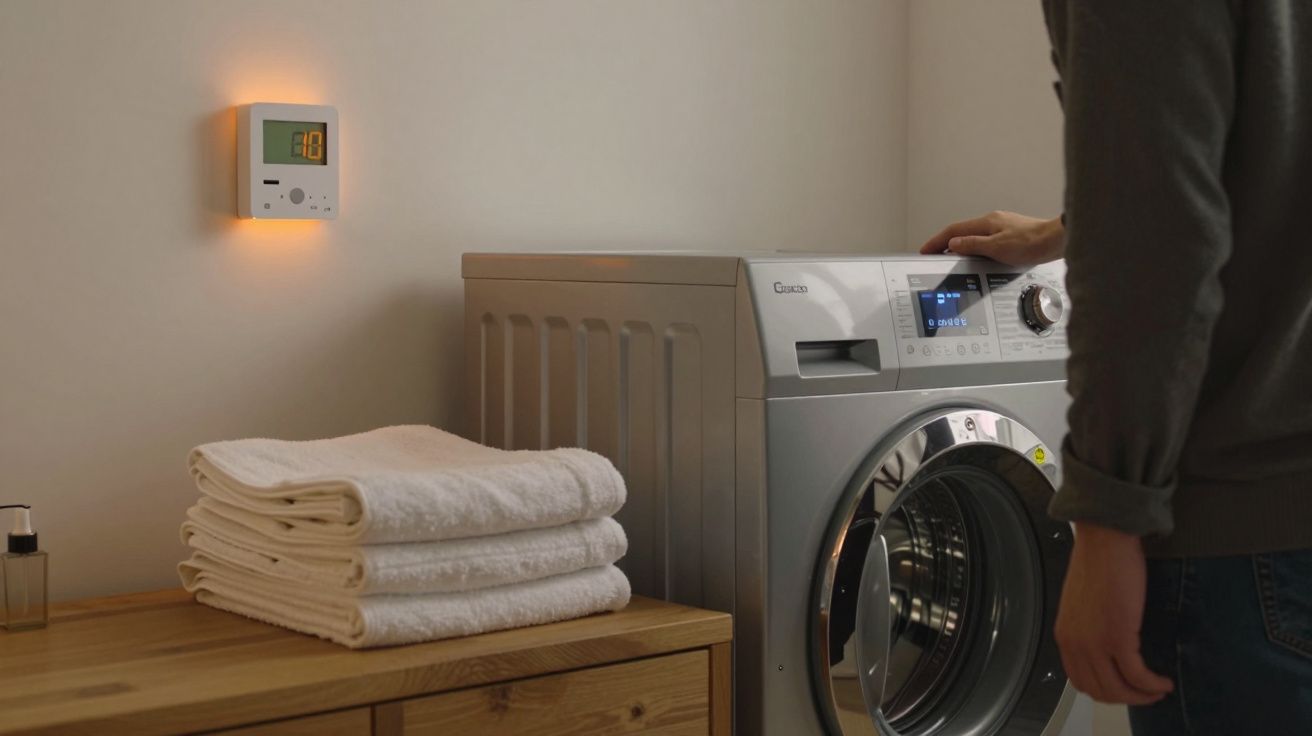
On a wet November evening, you yank a load of towels out of the tumble dryer. They’re hot, crisp, almost too sharp at the edges. A faint scorched-cotton smell hangs in the utility room while the smart meter in the hall quietly glows a warning shade of orange. The radiators are already on, the tariff has just crept up again, and yet the drum is still spinning most nights.
Most of us don’t really “set” our tumble dryer at all. We jab the same button we’ve always used-Cottons, Extra Dry or whatever sits closest to our thumb-slam the door and hope for the best. Dry is dry, we tell ourselves. Towels survive, the bill is just the bill. It feels like a small, fixed cost of winter.
Engineers who test and repair these machines tell a different story. Hidden behind those familiar programme names is one quiet option that makes a disproportionate difference: to your energy use, to the life of your towels, and to how hard the dryer has to work. It’s not a new gadget or an expensive upgrade. It’s a single setting you can change in under a minute.
Once you see what it does, it’s hard to unsee.
The innocent tumble‑dryer habit that cooks your towels (and your bill)
Look closely at your control panel and you’ll usually see more than just “Cottons”, “Synthetics” or “Mixed Load”. Most modern dryers let you choose a dryness level: “Iron Dry”, “Cupboard Dry”, “Cupboard Dry+”, “Extra Dry”, sometimes even “Bone Dry”. Many machines quietly default to the top of that scale.
It feels comforting. Extra dry sounds cleaner, safer, more thorough-especially in winter when the air is cold and you dread any hint of damp. So, understandably, plenty of people just leave the machine on its most aggressive setting all year round. Towels come out hot and rigid, with that hotel‑laundry crackle, and it feels like you’ve done the right thing.
In engineering terms, you’ve just asked the dryer to push well past “dry enough” into “bone-dry at any cost”. Once the bulk of the water has gone, getting the last thin film of moisture out of dense cotton loops is where the energy bill quietly explodes. The fabric stops cooling itself by evaporation, the drum air runs hotter, and the machine keeps burning electricity to drive water content from, say, 3% down to 0%.
For your towels, that final stretch is not a kindness. Repeated high‑heat over‑drying bakes the cotton, flattens the loops and literally wears fibres off into lint. Think of it like leaving a cake in the oven for another 20 minutes “just to be sure”. It doesn’t make it safer; it just makes it tougher and drier than it ever needed to be.
The one change: drop your dryness level a notch
The small, practical move engineers recommend before winter is this:
Turn your dryer down from “Extra Dry” (or its equivalent) to the next level below-usually “Cupboard Dry” or “Iron Dry”-and let that become your default.
On many machines, the last used dryness level is remembered for future cycles. Change it once now and, for most of your winter loads, the dryer will stop earlier by design.
In plain terms, that means:
- Your towels will still come out properly dry to the touch.
- The machine will avoid the most wasteful, fabric‑cooking part of the cycle.
- You trim a noticeable slice off the running time and the energy use.
If your panel offers both a temperature choice and a dryness level, engineers suggest a simple rule of thumb for towels:
- Heat: Standard/medium heat in winter is fine for towels; reserve high for occasional emergency drying.
- Dryness: Aim for Cupboard Dry as your everyday setting, not Extra or Bone Dry.
If you’ve got somewhere to hang things for the final 10–20 minutes-a clothes horse, a warm bathroom, even the back of a door-you can go one step further and choose Iron Dry for towels and bed linen. They’ll leave the drum just very slightly cool and damp, then finish off the last few percent of drying in the air for free.
The physical work your dryer has to do doesn’t change with the brand name on the door. Vented, condenser, heat‑pump: they all burn time and energy hardest in those last few minutes of chasing absolute dryness. You’re simply deciding not to pay for that part.
Why this tiny tweak matters so much in winter
Dryers are usually rated on a standard test load. In labs, changing the dryness level by a single step often shaves 10–30 minutes-and roughly 10–20% of the electricity-from a full cottons cycle. Over a winter where you’re running three or four loads a week, that’s not pocket change.
From an engineer’s point of view, two things happen when you insist on “Extra Dry” for everything:
Energy climbs steeply
Once towels pass the “cupboard dry” point, there’s hardly any water left to remove. Most of the power you’re drawing is simply keeping a drum of heavy fabric very hot. It’s the least efficient phase of the whole process.Wear and tear speeds up
Every minute of extra heat and tumbling is mechanical stress. Seals, bearings and heating elements don’t have an easy life. Neither do towel fibres. The fluff in your lint filter is not dust from nowhere; it’s cotton you paid for that has literally been tumbled off your textiles.
“We very rarely see a machine killed by someone using a moderate setting,” one UK service engineer put it. “It’s the ‘always on max, always on timed extra dry’ pattern that cooks the insides and wrecks laundry. The dryer’s sensors are actually trying to help you if you let them.”
There’s a comfort angle, too. Towels that are repeatedly over‑dried tend to go stiff and scratchy, no matter which fabric softener you use. By stopping earlier-while there’s just enough internal moisture left for the fibres to relax-you often get that thick, springy feel back without changing your detergent at all.
How to actually use it when life is hectic
The theory is simple; the challenge is fitting it into the blur of school runs, late‑night laundry and surprise muddy football kits. A few tweaks help this new setting survive real life.
1. Decide when you really need “Extra Dry”
There are times when you simply do: guests arriving in an hour, only set of school towels, no spare bedding. Keep that top setting in your back pocket for those genuine emergencies.
For everything else-weekly towel wash, bed linen, general clothes-let “Cupboard Dry” or “Iron Dry” be your quiet default.
2. Let the sensors work instead of the timer
If your machine offers both “Timed” and “Cupboard Dry / Extra Dry” style options, engineers almost always prefer the sensor‑based programmes. The built‑in humidity sensors cut the heat once the load reaches the target dryness, rather than blindly running for 90 minutes regardless.
Timed high‑heat setting + small load of towels = a recipe for baked, over‑dried fabric and unnecessary wear on the heating element.
3. Pair the dryer with somewhere to finish off
If space allows, treat the dryer as the heavy lifter, not the final act. For towels and cottons in winter:
- Run on Iron Dry or Cupboard Dry.
- Shake them out as you unload (this helps the loops loft up again).
- Drape them over a rack, banister or radiator for the last few minutes.
You still avoid that depressing all‑day indoor drying fug, but you’re no longer paying peak‑rate electricity for the most inefficient part of the process.
4. Avoid the common traps
These small mistakes make the “better” setting look worse than it is:
- Overloading the drum – Sensors can’t read moisture properly if towels are rammed in. You end up with mixed results and blame the setting.
- Not cleaning the filters – A clogged lint filter or heat‑exchanger forces the machine to run hotter for longer. Your bill goes up whatever setting you use.
- Mixing fabrics wildly – Heavy towels and light synthetics in one load confuse sensors. Where possible, keep similar fabrics together so “Cupboard Dry” actually means what it says.
Here’s a quick way to think about it:
| Old habit | What it really does | Smarter swap |
|---|---|---|
| Always using “Extra/Bone Dry” on high heat | Over‑dries fibres, uses maximum power | Use “Cupboard Dry” on standard heat for everyday loads |
| Timer set to 90 minutes “just in case” | Ignores sensors, often runs long past dry | Let an automatic sensor‑dry programme stop itself |
| Leaving towels in a hot drum for ages | Bakes creases and stiffness into fabric | Unload promptly, shake, and finish on a rack if needed |
Why engineers suggest doing this before winter really bites
Winter is when all your quiet inefficiencies stack up. Radiators are on, showers are hotter, laundry piles rise with every storm‑lashed dog walk and PE kit. The tumble dryer goes from occasional helper to near‑daily habit.
If you wait until January’s bill to rethink it, you’ve already paid for two months of over‑drying.
Changing the dryness level now, while you’re still in that autumn adjustment phase, gives you a chance to:
- See how “Cupboard Dry” actually feels on a couple of loads.
- Tweak your routine (short hanging time, different wash spin speed) before schedules get frantic.
- Protect newer towels and bedding from a long season of unnecessary heat.
It’s a small, one‑time decision that quietly repeats itself every time you press start. No apps, no smart plugs, no elaborate laundry philosophy. Just a single toggle away from “maximum, always” and towards “enough, most of the time”.
FAQ:
- Won’t “Cupboard Dry” or “Iron Dry” leave my towels smelling damp in winter?
For most machines and reasonably spun loads, no. “Cupboard Dry” is designed to be dry enough to store immediately. If your towels feel cool but not wet, that’s fine-it’s not damp, it’s just not baked. If things do smell musty, the culprit is usually poor ventilation, an overloaded machine, or a low spin speed on the washing‑machine cycle, not the dryer setting itself.- Do I still kill germs and dust mites if I don’t use the hottest, driest setting?
Hygiene is mainly about reaching a sufficient temperature for long enough earlier in the cycle, not obliterating every last water molecule. By the time a sensor recognises “Cupboard Dry”, your towels have already spent plenty of time at high temperature inside the drum. If you’re concerned about allergies, focus on the wash temperature and a good spin, then use a standard‑heat sensor‑dry cycle.- I have a heat‑pump dryer. Does this advice still apply?
Yes. Heat‑pump dryers are more efficient overall, but they follow the same curve: chasing the very last bit of moisture still costs disproportionate time and energy. Dropping from “Extra Dry” to “Cupboard Dry” reduces run time and wear just as effectively on a heat‑pump model.- Is using the Eco programme the same as lowering the dryness level?
Not quite. Eco modes usually adjust drum speed and temperature profile to use less power, but many still aim for a fairly high dryness level. For the biggest benefit, combine them: choose an Eco or low‑heat cottons programme and set the dryness level to “Cupboard Dry” instead of “Extra/Bone Dry”.- How do I know what my current default is?
On most machines, it’s whatever shows on the display when you turn the dial to your usual programme, before you press start. Look for a small icon or text-“Cupboard Dry”, “Extra Dry”, sometimes a row of bars. Tap the dryness button once or twice, note the change, then leave it one notch below the highest option. The machine will generally remember that choice for next time.





Comments (0)
No comments yet. Be the first to comment!
Leave a Comment