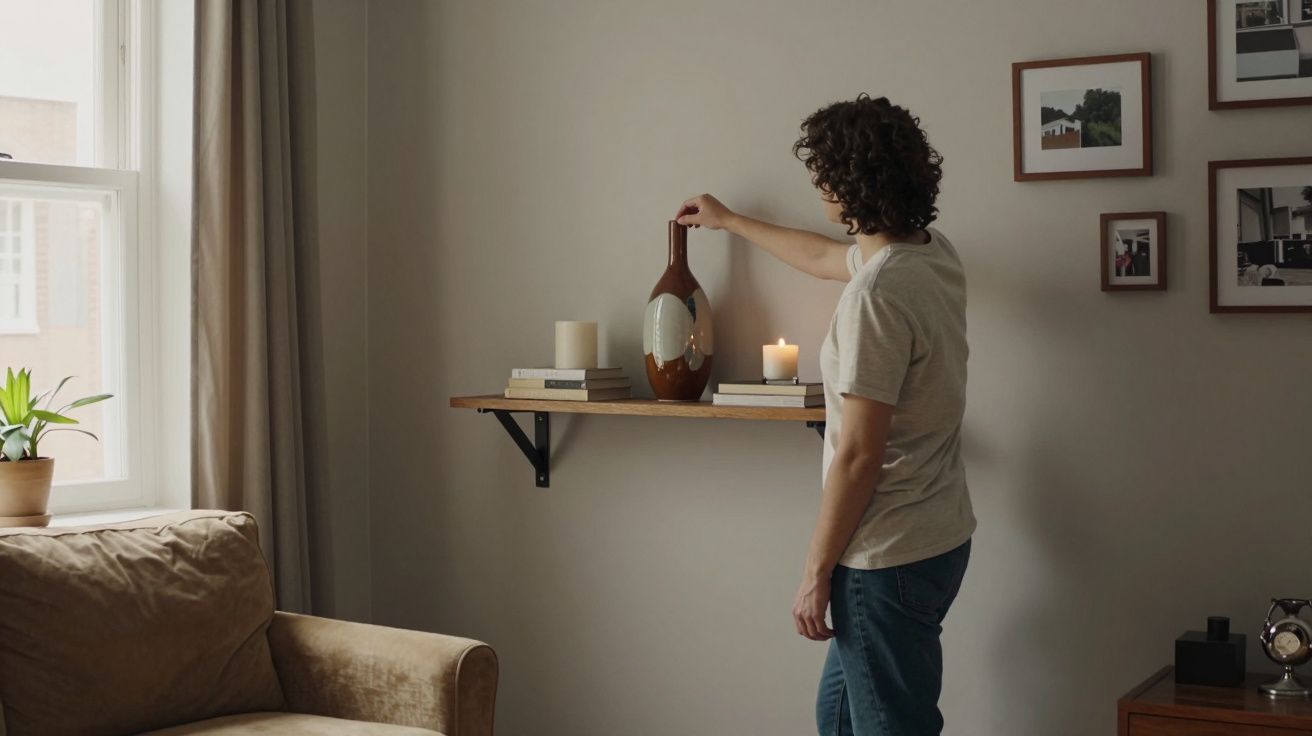
The shelf had everything going for it. Fresh paint, warm wood, a neat row of books, a candle that had definitely been bought “for the vibe”. My friend stood back, head tilted, and said what most of us think but rarely admit out loud: “Why does it still look… a bit student-y?”
We pushed a vase to the left, stacked three books on their side, added a bowl, then took the bowl away again. Ten minutes later it still looked more like storage than a styled corner you’d see in a magazine.
That’s usually the moment a decorator walks in, nudges a few objects into place, and suddenly the whole wall looks intentional. No new furniture, no shopping spree. Just a quiet pattern they repeat automatically: groups of three.
Designers will tell you they do a lot of complicated things with proportion and balance.
But when you really watch them work, a simple rule keeps reappearing on every surface.
Why shelves are weirdly hard to get “just right”
Shelves sit in a strange middle ground between practical and decorative.
They have to hold real stuff – books, speakers, routers, kids’ trophies – but they’re also at eye level, so every imbalance shouts.
Too full and it feels cluttered and noisy. Too empty and it feels like you never finished moving in. We add one more candle, one more picture frame, then wonder why it still doesn’t look like the calm, effortless images on Pinterest.
Designers know something most of us forget: your eye doesn’t read shelves as a list of objects, it reads them as little scenes.
Change the structure of those scenes and the whole wall settles.
That’s where the rule of three quietly changes everything.
The decorator’s “rule of three”, in plain English
Ask three different stylists and they’ll explain it three different ways, but it always comes back to the same idea: our eyes love odd numbers, especially three.
Three objects create a tiny triangle your brain can process in a single glance. It feels balanced but not rigid, intentional but not staged. Two is a pair (too formal), four looks like a grid (too stiff). Three is where it starts to breathe.
When decorators talk about the rule of three for shelves, they usually mean:
- Group objects in odd numbers, most often three.
- Make sure those items aren’t identical – vary at least:
- Height
- Shape
- Texture or finish
- Height
- Let them form a loose triangle, not a straight line.
- Give them air: leave some negative space around the group.
A designer I interviewed summed it up like this:
“If you can point to three things talking to each other, the shelf starts to look designed. Everything else becomes background.”
That triangle might be a tall vase, a medium candle and a small stack of books.
Or a framed photo, a plant and a ceramic bowl. Three different voices, one little conversation.
Once you see it, you start spotting it in every styled room shot.
A three-step, five-minute way to style any shelf
The good news is you don’t need new décor to make this work.
You mostly need a method and a bit of editing.
Here’s the routine stylists repeat on almost every project:
Clear and sort (2 minutes)
Take everything off the shelf. Yes, everything. Lay it out on a table or the floor.
Pull together similar things: books here, vases there, little objects in another group. This is the only vaguely “messy” moment, and it’s over quickly.Build mini groups of three (2 minutes)
Start picking trios:- 1 tall piece (vase, lamp, taller stack of books)
- 1 medium (frame, medium candle, small plant)
- 1 low or grounding piece (bowl, paperweight, shallow stack of books)
- 1 tall piece (vase, lamp, taller stack of books)
Put your tallest item slightly off-centre, add the medium one overlapping it a bit, then tuck the smallest piece in front or to the side. You’re making a loose triangle, not a marching band.
- Place, step back, edit (1 minute)
Pop one trio on the left of the shelf, one on the right, maybe one centred on another shelf. Leave breathing room between them.
Then – and this is the part stylists never skip – step back across the room. Remove one thing that feels like “just clutter”, slide the remaining two a little closer, and stop. Better to have one strong group of three than five half-hearted objects.
If you’re styling a tall bookcase, you don’t need a trio on every single shelf.
Designers often alternate: one shelf is mostly books, the next carries a group of three, then back to books again.
Let’s be honest: nobody empties every shelf in their house on a Tuesday night. But if you do this on just one spot – the living room alcove, the hallway console – you’ll see how quickly it snaps from “functional” to “finished”.
How the rule of three looks in real rooms
Once you get the hang of the triangle, you can plug it into almost any style. Here are a few formulas decorators lean on again and again.
Living room TV unit
- Left side: tall plant, stack of two coffee table books, small sculptural object.
- Right side: medium lamp, low bowl, remote-control box or small tray.
The TV stays clean in the middle; the trios soften the boxiness without crowding it.
- Left side: tall plant, stack of two coffee table books, small sculptural object.
Open kitchen shelves
- Top shelf: set of three – jug, smaller jug or jar, stack of plates.
- Lower shelf: three everyday things you actually use – mugs, oil bottle, salt cellar – grouped together instead of scattered along the whole length.
It still works hard, but now it looks curated, not chaotic.
- Top shelf: set of three – jug, smaller jug or jar, stack of plates.
Bedroom bedside table
- Tall: lamp.
- Medium: framed photo or book standing upright.
- Small: dish for jewellery or a candle.
One quiet trio and a glass of water is usually enough; everything else can live in the drawer.
- Tall: lamp.
Notice what’s happening: you’re not hiding real life, just deciding where it’s allowed to be visible.
The more deliberate your little groups of three, the more forgiving the rest of the room becomes.
Common tweaks decorators make in seconds
Once the basic trios are in place, stylists tend to do three quick checks:
- Heights: Do you have a clear tall–medium–small rhythm, or are all three pieces almost the same height? If they are, raise one on a book or swap something out.
- Textures: Mix at least two textures – glass with wood, ceramic with linen, metal with greenery – so the group doesn’t feel flat.
- Colours: Keep to one main colour story per shelf. Three wildly different colours per trio is where things start to look like a souvenir shop.
If you’re ever stuck, decorators often use the “one of each” fallback:
one thing that’s alive (plant or flowers), one thing that’s personal (photo, object with a story), one thing that’s purely sculptural (a shape you just like).
That’s still a rule of three – just in a different language.
Key ideas at a glance
| Key idea | Detail | Why it helps you |
|---|---|---|
| Group in threes | Use odd numbers, especially three, with varied height and shape | Instantly looks more styled and less like storage |
| Think triangle, not line | Place tall, medium and small items in a loose triangle | Creates balance and flow without feeling stiff |
| Edit and leave space | Remove one thing, then another, until the shelf can “breathe” | Makes the room feel calmer and more intentional |
FAQ:
- Do I have to stick to three items on every shelf? No. The rule of three is a starting point, not a law. Some shelves will have a strong trio plus books, others just a pair if that suits the space. The aim is to create clusters your eye can read quickly.
- What if I own mostly small, similar objects? Corral them. Use a tray, shallow bowl or stack of books as one “base” item, then add two small objects on top or beside it. Together they read as a single, more substantial piece within your group of three.
- Can the rule of three work with maximalist or colourful styles? Yes – in fact it’s what stops maximalism becoming pure chaos. You can have lots of things, but arrange them in repeating trios so the eye gets little rests and patterns.
- Does this only apply to shelves? It’s strongest on surfaces – coffee tables, mantels, bedside tables – but the same idea works on sofas (three cushions), gallery walls (clusters of three frames), even pendant lighting (three lights over an island).
- How often should I restyle once it’s “done”? Only when something starts to annoy you. Many stylists do a tiny refresh with the seasons – swap a candle, add a branch or a book – but the basic rule of three can stay in place for years.





Comments (0)
No comments yet. Be the first to comment!
Leave a Comment