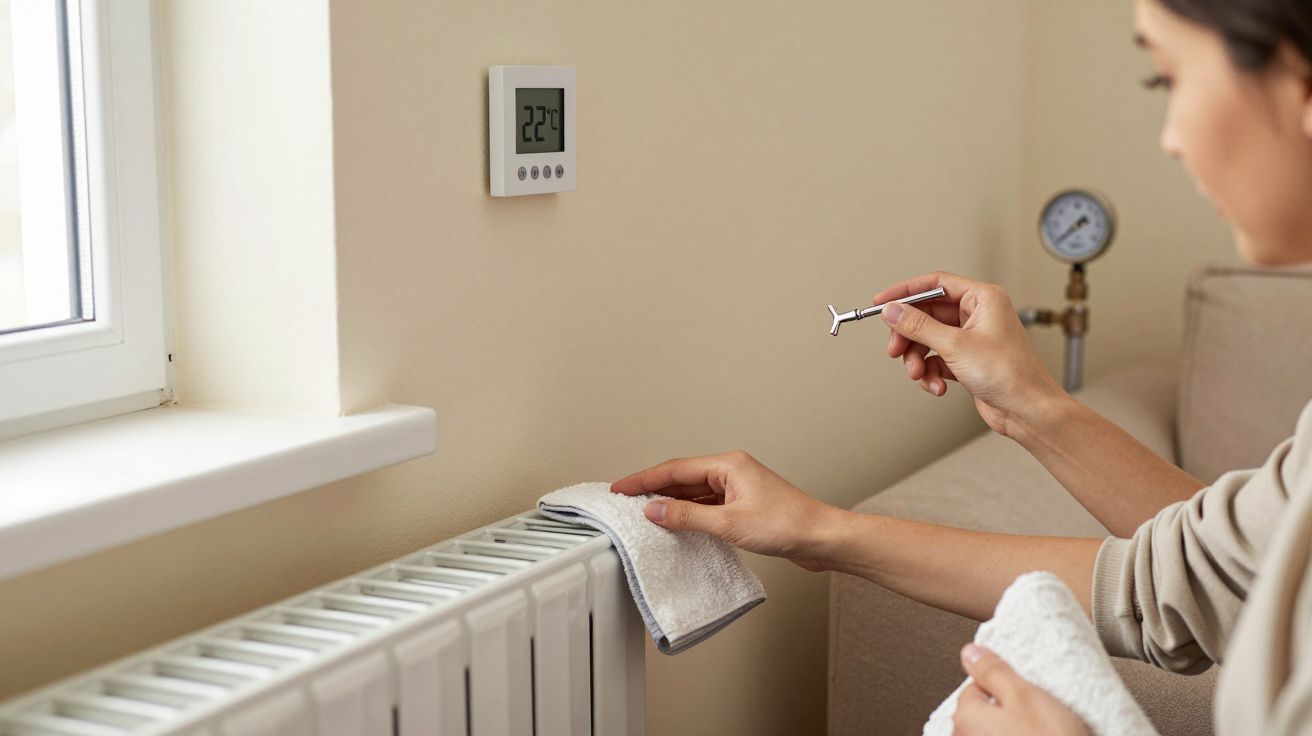
That first sharp October evening, you twist the room stat up and wait for the familiar tick of pipes waking. One radiator sulks, warm at the bottom, chilly at the top. Somewhere in your head: that line you’ve heard a dozen times – “You should bleed them every year, like clockwork.” So you fetch the little silver key, towel in hand, feeling oddly like you’re performing a seasonal ritual rather than fixing a fault.
Ask a heating engineer, though, and you get a different story. They don’t wander around houses every autumn, dutifully cracking every valve. They listen, they feel the panels, they glance at the boiler pressure. Then they decide whether any bleeding is needed at all.
The quiet truth: most UK radiators don’t need bleeding on a schedule. They need it when the system tells you they do.
What heating engineers notice before they touch a bleed key
Watch a good engineer walk into a chilly semi and you’ll see it. They don’t head for the radiators first; they head for the boiler and the hallway.
They run a hand along the panels, from valve to valve, feeling for that giveaway pattern: hot at the bottom, cool or stone cold at the top. They listen for trickling sounds in pipes, a faint gurgle when the pump starts, the hiss of air moving where only water should be. They glance at the pressure gauge on a combi or system boiler – has it dropped below 1 bar, or does it climb after a recent top-up?
In a three-bed in Nottingham, a homeowner complained that “the whole system needs bleeding again – it’s that time of year”. The engineer fired the heating, checked each radiator, and found just one bedroom panel with a cold top. The rest were even and hot. The culprit was a recent decorating job: the rad had been off and on again, dragging in a pocket of air. The others were fine.
The logic is simple. Air in the system leaves fingerprints, just like electricity in a socket or grease in a sink. You can feel it, hear it, and see it on the boiler gauge. You don’t guess. You read the signs.
What actually happens when you “bleed” a radiator
There’s nothing mystical about that little key. You’re not “tuning” the system; you’re letting trapped air escape so hot water can fill the entire panel.
In a sealed system – most modern combi and system boilers in UK homes – water circulates under pressure. If air gets trapped at the high points (usually the top of radiators, often upstairs), it forms a bubble. Water can’t occupy that space, so the top third of the radiator stays cold while the bottom does all the work.
Bleeding does two things:
- It vents the air pocket so water can rise to the top again.
- It slightly drops the system pressure, because you’re letting out a mix of air and a mist of water.
That second bit is why engineers don’t “bleed for the sake of it”. Every unnecessary venting session on a sealed system means you may need to top up the boiler more often. Topping up too frequently introduces more fresh water – and with it, more dissolved oxygen, which long term is bad news for steel radiators and internals.
Open-vented systems (with a little feed-and-expansion tank in the loft) behave differently, but the principle’s the same: you’re removing air so water can do its job. You just don’t get a pressure gauge to nag you.
The myth vs the numbers: how often most UK systems really need it
Here’s where the folk wisdom bumps into real practice.
Ask around and you’ll hear:
- “Bleed every radiator at the start of each winter.”
- “Do them monthly so the system runs efficiently.”
- “If you don’t, your boiler will work twice as hard.”
Heating engineers roll their eyes at that, then admit there’s a small grain of sense hiding in the exaggeration.
What they actually see in typical homes:
- New or recently altered systems – a bit of air for the first few weeks as tiny bubbles work their way up. You might bleed a couple of radiators once or twice, then they settle.
- Older open-vented systems – the odd radiator collecting air at the highest points, especially after pipe work or if the loft tank has run low.
- Sealed combi systems in good nick – radiators that only need bleeding when there’s been a drain-down, a part replacement, or a clear symptom like gurgling or cold tops.
For most well-maintained sealed systems, heating engineers quietly aim for this rule of thumb:
- Check radiators once a year when you first fire the heating up.
- Bleed only the ones that show symptoms – cold at the top, noisy, or not heating properly.
- Ignore the myth that every radiator must be cracked open yearly “just because”.
In many modern flats, engineers go years between bleeds on any given radiator. That’s not neglect. That’s a system that’s sealed, sized correctly, and left alone to do its job.
When you should absolutely bleed (and when you should not)
The system will usually tell you when it wants the key. The trick is knowing which symptoms point to air – and which don’t.
Good reasons to bleed a radiator
- The radiator is cool or cold at the top but hot at the bottom.
- You hear sloshing or gurgling from that radiator or the nearby pipes.
- One upstairs radiator is underperforming while others on the same floor are fine.
- A radiator has been removed for decorating and refitted recently.
- After a system has been drained and refilled, and the installer has asked you to check for air pockets.
Times bleeding won’t help – or can make things worse
- The radiator is cold at the bottom but hot at the top – this suggests sludge, not air. Bleeding won’t fix it; you need cleaning, not venting.
- Multiple radiators are lukewarm all over – likely a balancing or boiler setting issue.
- Your boiler pressure keeps dropping and radiators often need bleeding – could indicate a leak or expansion vessel issue. Repeated bleeding just hides the problem.
- You’re on a sealed system and nervous about topping up pressure – constant DIY bleeding without understanding the pressure gauge can leave the boiler locking out.
If in doubt, an engineer will often do a quick test bleed on the suspected radiator: if air hisses for a few seconds then water comes steadily and the rad warms fully, you’ve nailed it. If only water comes out straight away, the problem lies elsewhere.
A simple once‑a‑year ritual that actually makes sense
Here’s the version of the “autumn radiator check” that heating engineers can live with.
Do this once a year, ideally the first time you properly fire up the heating:
- Turn the heating on and let it run for 20–30 minutes.
- Walk the house and feel each radiator, top and bottom, left and right.
- Note any that are obviously cooler at the top or making gurgling noises.
- On a sealed system, glance at the boiler pressure first (cold, it should usually sit around 1–1.5 bar; check your manual).
- Bleed only the problem radiators, one at a time, with the heating off, a cloth under the bleed valve, and only until water (not spluttering air) emerges.
- On a sealed system, recheck the boiler pressure afterwards and top up to the recommended range if necessary.
That’s it. No need to march methodically around every panel twice a year like it’s a tax return. A targeted, symptom-led check keeps efficiency up without overfussing a system that would rather be left alone.
Common radiator symptoms decoded
| Symptom | Likely cause | Will bleeding help? |
|---|---|---|
| Hot at bottom, cold at top | Trapped air | Yes, usually |
| Cold at bottom, hot at top | Sludge / debris | No, needs cleaning |
| Whole radiator lukewarm | Balancing / flow issue | Sometimes, but unlikely |
| Gurgling sounds in one radiator | Air pocket | Often, yes |
| Frequent pressure loss + air | Leak / system fault | Bleeding masks the issue |
Engineers read this pattern before they reach for tools. You can do the same with a careful hand and a bit of patience.
Why “bleeding for the sake of it” is falling out of favour
In older, open-vented systems with a loft tank glugging away, the idea of frequent bleeding made more sense. Tiny amounts of air were constantly introduced, and homeowners were used to the odd top-up and vent.
Modern sealed systems changed the game. Less fresh water enters, inhibitors protect the metal, and air should be a rare visitor, not a seasonal tenant. Over-bleeding these systems can:
- Encourage constant pressure topping-up, adding more oxygenated water each time.
- Mask underlying issues like micro-leaks or expansion vessel problems.
- Tempt people to fiddle with valves and caps they don’t fully understand.
As one veteran engineer in Croydon put it:
“If I’m bleeding your rads every autumn, something upstream isn’t right. My job is to fix the cause, not keep you on a yearly hissing ritual.”
The new mindset is quieter: design and maintain the system so air doesn’t build up often, then deal with it smartly when it does.
A practical rule to live by
Treat radiator bleeding like calling a plumber or resetting the fuse board: a response to a clear signal, not a fixed date on the calendar.
- Use your hands and ears first: feel for cold tops, listen for gurgles.
- Check the boiler pressure on sealed systems before and after.
- Bleed only where symptoms justify it.
- Call a pro if the same radiators keep collecting air, or if pressure won’t hold.
Do that, and you’ll spend less time chasing myths and more time simply being warm.
FAQ:
- How often should I bleed my radiators in a typical UK home? Most sealed systems only need individual radiators bled when they show symptoms (cold at the top, gurgling) and as part of an annual check when you first turn the heating on. There’s no need to bleed every radiator on a fixed schedule if they’re already heating evenly.
- Is it safe to bleed radiators myself? Yes, if you’re careful. Turn the heating off, use the correct key, protect walls and carpets with a cloth, and only open the valve slightly until air stops and water flows steadily. On sealed systems, always recheck boiler pressure afterwards.
- My radiators are hot at the top but cold at the bottom – should I bleed them anyway? No. That pattern usually points to sludge or poor circulation, not air. Bleeding won’t help and may lower system pressure needlessly. You’ll likely need balancing, cleaning, or professional flushing.
- Why do my radiators keep needing bleeding every few months? Persistent air build-up can signal a system fault: a tiny leak, corrosion creating gas inside the radiators, or issues with the expansion vessel or automatic air vents. Repeated bleeding is a symptom, not a cure – get an engineer to investigate.
- Do new radiators and systems need more frequent bleeding at first? Often, yes. After installation or major pipe work, small air bubbles can work their way up over the first few weeks. A couple of short bleed sessions on the affected radiators is normal; it should settle once the system has run for a while.

Comments (0)
No comments yet. Be the first to comment!
Leave a Comment