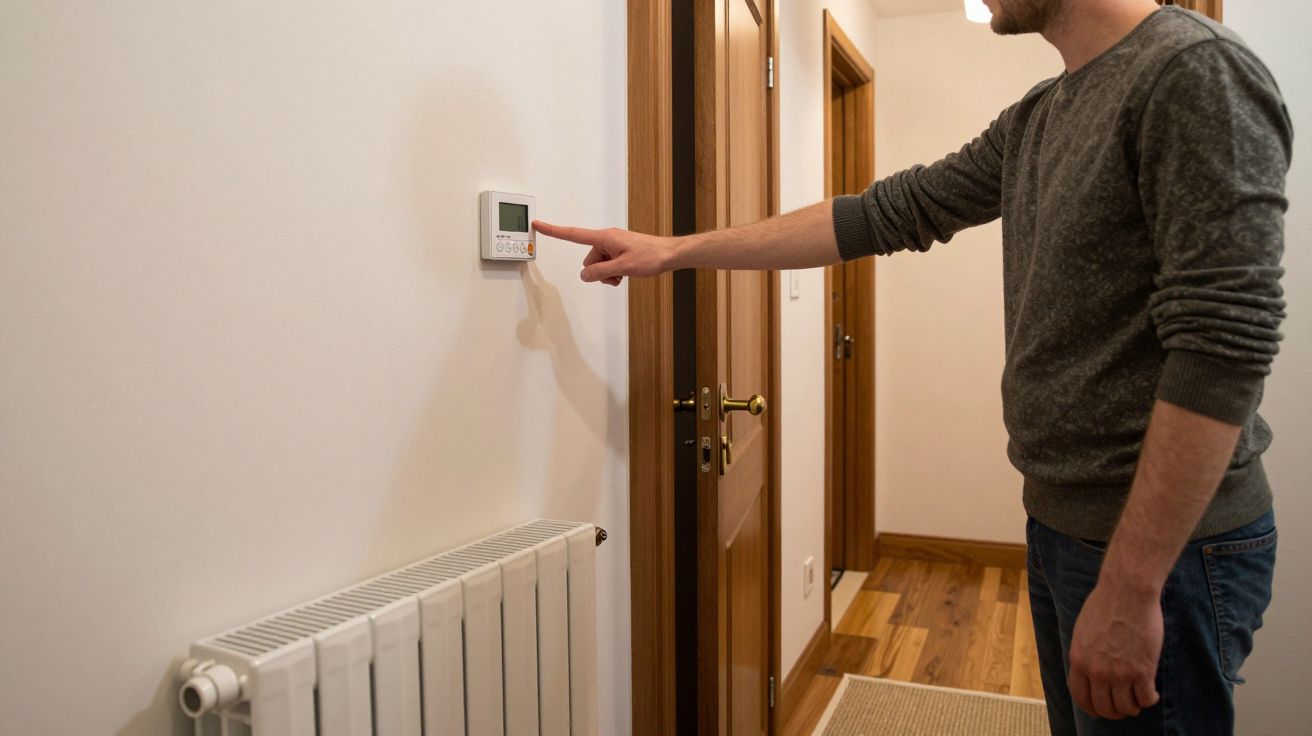
The first time an energy assessor walked through my front door, he didn’t look at the boiler. He walked straight past the kitchen, paused in the hallway, and stared at a little white box above the radiator.
“That’s costing you money,” he said, tapping the thermostat. The hallway was chilly, the living room was stuffy, and the boiler had been clicking on and off all day. I’d been tweaking the temperature and blaming the weather. The problem was the wall.
A badly placed thermostat won’t shout, beep, or flash a warning. It just quietly misreads your home, calls for heat when you don’t need it, and leaves you paying for rooms that are already warm. Move it a few metres, and the whole heating system starts to behave differently.
According to domestic energy assessors, the wrong location can easily nudge your heating use up by 10–15%. On a typical UK gas bill, that’s on the order of £150 a year for heat you never enjoy-just because the thermostat is in the wrong place.
A thermostat on the wrong wall is like a speedometer that lies. You keep paying, but you never quite feel in control.
The small placement mistake that snowballs
Most of us inherit our thermostat. It came with the house, stuck in the hallway or by the front door, and we assume there’s a good reason it’s there. Often, there isn’t.
A thermostat only knows the temperature right where it’s sitting. Put it in a cold draught, above a radiator, or in direct sun, and it will make decisions for the whole house based on that one confused reading. The boiler responds obediently, even if every other room is already warm.
Energy assessors see the same pattern again and again: the hallway is the coldest space, with an exterior door, bare floorboards and no soft furnishings. The thermostat there never quite gets to its set point, so the boiler keeps firing and the living room creeps from comfortable to stuffy. You pay for the extra degrees you never asked for.
How a bad location quietly adds £150 a year
On paper, the maths is simple. Heating is usually the biggest part of your gas or electricity bill. If the thermostat is “seeing” the wrong temperature, it asks for more heat than you need. A slight overshoot every day adds up.
Imagine this:
- The hallway thermostat sits in a draught by the front door and rarely reaches 20°C.
- To feel comfortable in the living room, you nudge the setting to 22–23°C.
- The hallway finally gets close to its target, but the main rooms hit 23–24°C instead.
You don’t feel 3–4°C warmer; your body adapts. What changes is the boiler runtime. Each extra degree you heat a home is commonly estimated to cost around 5–10% more in heating energy. If a misplaced thermostat effectively adds two degrees to what the boiler delivers, that can mean 10–15% more on your heating portion of the bill.
Over a year in a typical UK home, that can run to roughly £150 in wasted energy-money spent compensating for a draughty hallway, a sunny patch of wall, or a radiator underneath a plastic box.
When the “control” room is the coldest or hottest spot in the house, your boiler is working to satisfy the wrong space.
The four worst places to put a thermostat
Energy assessors see the same problem spots so often they could draw them from memory. If your main room thermostat lives in any of these, it’s doing you no favours.
Right by the front (or back) door
Every time someone comes in, a blast of cold air hits the sensor. The thermostat thinks the whole house has cooled sharply and calls for heat. The boiler cycles more than it needs to, and rooms further inside end up hotter than planned.Above or beside a radiator, heater or TV
The air around a heat source warms faster than the room as a whole. A thermostat there will think the house is cosy long before you feel it on the sofa, so it turns the boiler off too soon. You compensate by turning the set temperature up-and stay on that expensive treadmill.In a rarely used cold corridor or utility room
Corridors and utility spaces often have fewer radiators, tiled floors and more exterior walls. They naturally run cooler. If the thermostat chases comfort in the corridor, living areas overshoot quietly in the background.In direct sunlight or behind heavy curtains
Sun on the thermostat warms its casing and fools the sensor into “seeing” summer on a winter morning. Behind a curtain or wardrobe, the air is still and can lag behind the real room temperature. Both distort the reading, both leave you adjusting settings more than you should.
Quick comparison: bad vs better spots
| If it’s here… | Typical problem | Move it towards… |
|---|---|---|
| By a draughty door | Overheating elsewhere to warm one cold corner | An interior wall in a main living space |
| Above a radiator or heater | Boiler cutting out early and comfort “yo-yoing” | A wall at least 1–1.5 m away from heat sources |
| In a chilly corridor | Long boiler runtimes and stuffy main rooms | The room you actually sit in most |
Where energy assessors say it should go instead
Ask three different assessors and you’ll hear the same principles. A room thermostat wants calm, average conditions, not extremes.
The usual guidance is:
- Choose a main living space – typically the lounge or open-plan living/dining area you use most in the day and evening.
- Aim for an interior wall – away from exterior walls that tend to be colder.
- Mount it about 1.2–1.5 metres from the floor – roughly “nose height” standing, where air is well mixed.
- Keep it away from direct heat and sun – at least a metre from radiators, stoves, TVs, lamps and big windows.
- Give it clear air – not hidden behind curtains, bookcases, or in a corner where air doesn’t circulate.
If you have thermostatic radiator valves (TRVs) on your radiators, they should work with the wall thermostat, not against it. The wall stat controls the boiler; the TRVs fine‑tune each room. Putting the wall stat in the main living space and leaving that room’s TRV fairly open lets it “lead” the system sensibly.
The best place for a thermostat is where you spend time, not where the builder happened to have a spare bit of cable.
A 10-minute home check you can do tonight
You don’t need special tools to work out if your thermostat is in the wrong place. A short walk and a bit of attention will usually tell you enough.
Ask yourself:
- Is it in the room you actually sit in most on a winter evening?
- Is that room consistently comfortable, or do you often feel too hot or too cold?
- Does the boiler click on and off frequently in short bursts?
- Do other rooms feel stuffy or overheated while the thermostat room still feels cool?
- Is the thermostat near a door, radiator, window, or TV?
If you answer “yes” to the last question and “no” to the first, you’re probably over‑ or under‑heating at least one area.
A simple experiment: on a cool day, put a basic room thermometer in the living room and another near the thermostat. Set the heating to your normal temperature. After an hour, compare the readings and how you feel. If the thermostat area is still cooler than you’d like elsewhere-or noticeably warmer-the boiler is serving the wall, not you.
Common myths-and easy fixes
There’s often a worry that moving a thermostat will be messy, expensive or not worth the bother. Energy assessors tend to disagree.
“It has to stay in the hallway; that’s how houses are done.”
Hallways were a convenient place for early wired stats, not an ideal one. Modern guidance favours a main living area. If you’re upgrading to a wireless or smart thermostat, you can often keep the wiring base where it is and move the sensor unit.
“Smart controls make placement irrelevant.”
Smart thermostats can learn patterns and respond to weather forecasts, but they still measure temperature in one spot. If that spot is misleading, the clever software is working from bad data. Good placement plus smarter control is where the real savings sit.
“I rent, so I can’t change anything.”
You may not be able to rewire, but you can still improve things:
- Ask your landlord or letting agent if a wireless thermostat upgrade is possible; it’s a value‑add for the property.
- Use TRVs sensibly to avoid overheating rooms far from the thermostat.
- Avoid blocking the thermostat with coats, furniture or shoe racks; even small obstructions affect readings.
“It’s only a couple of degrees-how much difference can that make?”
A “couple of degrees” every day, for months, is exactly how small inefficiencies become triple‑figure bills. Shaving just 1°C off average heating temperature is widely estimated to save around 5–10% on heating energy. Getting the thermostat into a truer position is often the cleanest way to make that adjustment feel painless.
Think of thermostat placement as a one‑off job that pays you back every winter without you having to think about it again.
When to call in help-and what to ask for
If your thermostat is an older wired model fixed to a bad wall, moving it usually needs an electrician or heating engineer. It’s often worth timing this with other work-boiler service, new boiler, or a controls upgrade.
Useful phrases when you’re getting quotes:
- “I’d like the main room thermostat moved into the living room on an internal wall.”
- “Can we switch to a wireless or smart thermostat so we can choose a better sensor position?”
- “Will the radiators and TRVs still be set up sensibly with the new thermostat location?”
A simple wireless thermostat isn’t especially expensive compared with a year’s heating bill, and many models let you mount the sensor on the wall with removable adhesive, avoiding plaster work.
FAQ:
- How do I know if my thermostat is in a bad place? Notice where you actually feel too hot or too cold. If the thermostat lives in a draughty hall, near a door, above a radiator or in a room you rarely sit in, and you’re constantly tweaking the setting, it’s a strong sign the placement is off.
- Can moving a thermostat really save around £150 a year? In many typical UK homes, a poorly placed thermostat can lead to rooms being heated 2–3°C more than necessary. Since each degree of overheating can add 5–10% to heating energy, correcting the location can easily trim a noticeable chunk-on the order of £150 a year for some households.
- What if I have TRVs on every radiator-do I still need a wall thermostat? Yes. TRVs control individual radiators, but you still need a main control to tell the boiler when to run. The wall thermostat should usually be in the main living space, with that room’s TRV fairly open so it can guide the system.
- Is it worth buying a smart thermostat just to fix placement? If your current thermostat is in a terrible spot and quite old, a basic smart or wireless model can be a cost‑effective fix, especially if you plan to stay in the property a few years. It lets you place the sensor where it reads more accurately and can add scheduling features that squeeze further savings.
- I can’t move it right now-what’s the next best thing? Keep the area around it clear, reduce draughts at nearby doors, and use TRVs to stop other rooms overheating. You can also slightly lower the set temperature and see if comfort actually changes; often the stat was simply compensating for its bad position.




Comments (0)
No comments yet. Be the first to comment!
Leave a Comment