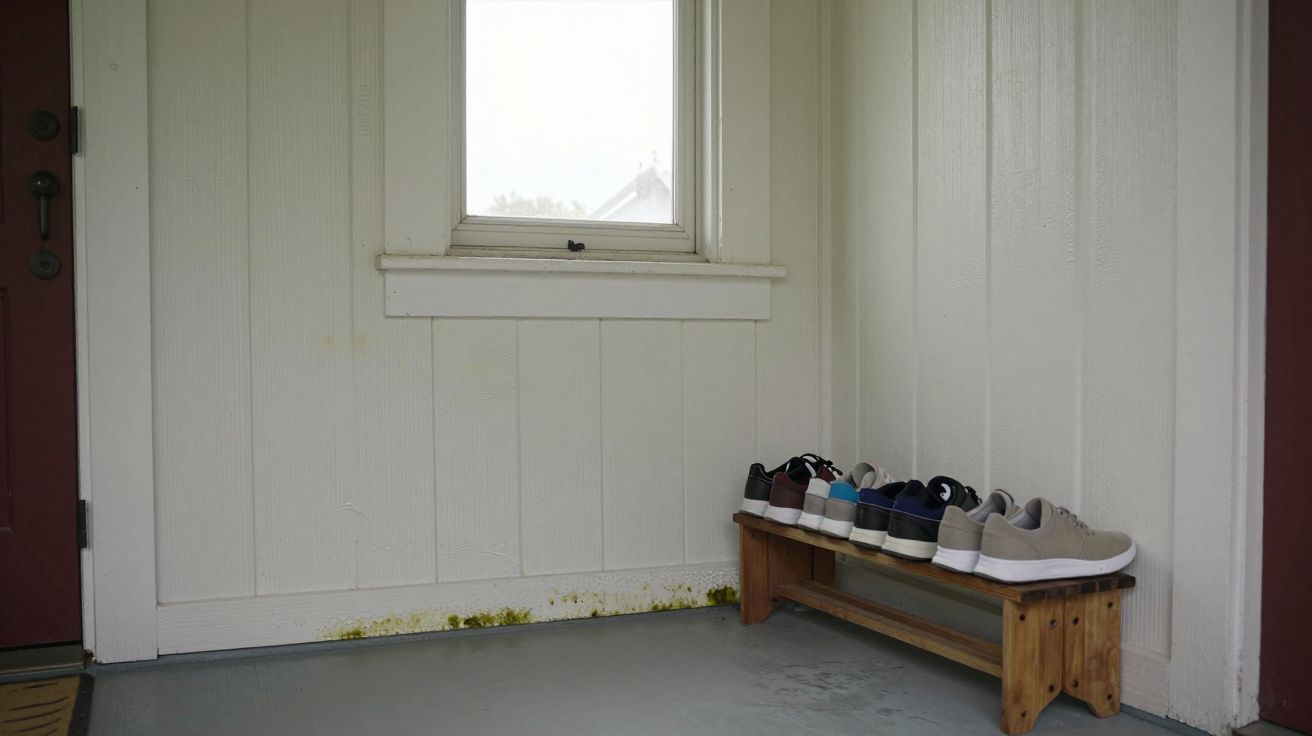
The habit starts as a kindness to your carpets. Trainers stay by the front door, lined up on the porch after a wet school run or a muddy dog walk. The rest of the house stays cleaner. The smell of damp fabric stays out of the hallway.
Then, a few winters in, a building surveyor walks in for a mortgage valuation and hesitates. There’s a faint dark tide mark at skirting-board height. Paint is bubbling near the threshold. A ring of grey-green fuzz is just starting in the corner behind the shoe rack.
What feels like a tidy routine to you is, in many homes, the first quiet chapter of a damp and mould problem. Especially in small, enclosed porches – the kind tacked onto the front of millions of British houses – those parked trainers are doing more than drying out. They’re helping moisture settle exactly where your home is coldest and least ventilated.
Surveyors see it so often that many now clock the line of shoes as a warning sign before they even lift a moisture meter.
Why porches are perfect little damp traps
On paper, a porch looks like a buffer zone: a semi-outdoor space where raincoats and muddy shoes can live in peace. In practice, the way most UK porches are built makes them miniature condensation labs.
They’re small, often unheated, and full of cold surfaces – glass, uPVC, concrete thresholds, brickwork. When you leave wet trainers there, the water in the fabric and soles slowly evaporates into a tiny air volume. The air becomes humid fast, then that moisture has nowhere easy to go.
As soon as the temperature drops at night, that humid air hits cold walls, doors and window reveals. Moisture condenses out and clings. Day after day, season after season, those micro-beads of water soak into plaster, timber trims and sealant lines. That’s exactly the environment mould spores and wood decay fungi are waiting for.
“From a surveyor’s point of view, a porch piled with wet shoes is a classic red flag,” notes one RICS surveyor. “It tells us this area is regularly damp, with poor ventilation and cold surfaces. That’s a recipe for mould.”
How wet trainers quietly feed mould
Each pair of soaked trainers can hold a surprising amount of water. Sports fabrics and foam soles are designed to absorb and cushion. After a rainy football match or run, you’re effectively leaving small sponges in a glass box.
Over a few hours, that water moves from the shoe into the air. Relative humidity in a porch can easily reach 70–80% on a damp evening. At that point, any cold surface – the internal face of the external wall, the metal threshold, the uPVC frame – sits below the dew point. Moisture has no option but to condense.
Once surfaces stay damp for long enough:
- Mould spores (which are already present in tiny numbers in most homes) begin to colonise paint and silicone.
- Timber skirtings and door linings start to swell, warp and, in time, soften.
- Plaster salts can migrate, leaving powdery patches or blistered paint.
You might notice a musty smell long before you see obvious black spots. By the time mould is visible behind the shoe rack or in the corners of the porch ceiling, the materials underneath have often been damp on and off for years.
The early clues surveyors look for around front doors
On inspections, surveyors rarely blame just one habit. But the “wet shoes in porch” routine shows up again and again in homes with localised damp around the entrance. They look for small, consistent patterns:
- Tide marks at low level: Slightly darker bands on plaster or wallpaper 5–20 cm above the floor, especially near where the trainers sit.
- Black or grey speckling: In corners, behind shoe racks, around the rubber seals of double-glazed units, or along the bottom of uPVC panels.
- Soft or crumbling skirting: Timber that dents easily with a fingernail, or paint that flakes off in sheets.
- Condensation on glass: Regular droplets on porch windows or the inner face of the front door, especially overnight and in the morning.
- Persistent odour: A “wet towel” or earthy smell that lingers even after cleaning.
Individually, these signs might look minor. Together, they tell a story of high humidity in a cold, enclosed space – made worse every time soaked trainers are parked up to “dry”.
Why it matters beyond a bit of surface mould
It’s tempting to treat porch mould as purely cosmetic. Wipe it off, spray something perfumed, move on. Surveyors – and insurers – see a different picture.
Long-term, chronic damp at the front of the house can:
- Undermine timber door frames, thresholds and sub-floors, leading to costly joinery repairs.
- Corrode metal fixings and door furniture.
- Damage finishes on the inside face of the external wall, which can later be (wrongly) blamed on rising damp.
- Aggravate asthma and allergies, especially in children who stand right in that space each morning pulling shoes on.
There’s also the resale angle. A patch of mouldy skirting or a musty porch can spook future buyers and valuers. It raises questions about what else is going on with moisture management in the property, even if the problem is currently confined to that small area.
Simple changes that protect both shoes and structure
You don’t need to empty the porch or start living in wellies. What building surveyors tend to recommend is a small shift in where and how wet footwear dries. The aim is to break the cycle: less moisture trapped in a cold, sealed box; more ventilation and controlled drying.
Practical steps that make a big difference:
- Dry off outside first: Knock mud and standing water off shoes at the doorstep. Use an outdoor boot brush if you have one.
- Limit soaking-wet pairs in the porch: Let truly sodden trainers drip in a covered outdoor area (carport, lean-to, balcony) for a few hours before bringing them in.
- Use absorbent mats, not bare tiles: A washable, absorbent runner under the shoe area will capture drips and can be regularly dried and laundered.
- Raise shoes off the floor: A slatted rack allows air to circulate around trainers and keeps moisture away from skirting and thresholds.
- Open something: Crack a porch window, open trickle vents, or leave the inner door ajar for short periods so humid air can escape into better-ventilated parts of the house.
- Rotate footwear: Avoid wearing and then storing the same pair every day in the same damp spot; give each pair a full dry-out between uses.
Where porches are unheated and tightly sealed, even a small electric towel rail or low-wattage radiator, used with care and ventilation, can help reduce chronic damp by slightly raising surface temperatures. Surveyors tend to see fewer mould issues where porches are either genuinely external, or integrated and gently warmed and aired.
Better spots to dry trainers, according to surveyors
Many survey reports now include practical advice about shoe storage because it crops up so often. The ideal is a place where water can evaporate without soaking cold corners and timber.
Options that usually work better than a sealed porch:
- A covered outdoor space: Under a canopy, in a shed with vents, or on a north-facing balcony where rain and direct sun are limited.
- A utility room with extraction: Drying racks near a mechanical extractor fan (or an openable window) disperse moisture far more safely.
- Over a tray in a ventilated hall: If space allows, keep the shoes just inside the inner door, not trapped in the colder porch zone, and open interior doors to share the load of moisture.
- Near (not on) a radiator: A rack positioned a short distance from a warm radiator can help, but only if the room has some ventilation; otherwise you simply move the condensation problem to another wall or window.
What surveyors caution against is any set-up where: lots of wet fabric sits very close to external corners, cold masonry, or uninsulated door frames in a room with little or no airflow. That description fits many small porches almost perfectly.
At a glance: how wet trainers affect a porch
| Issue | What’s happening | Why it matters |
|---|---|---|
| High humidity | Water evaporates from shoes into a tiny air volume | Drives condensation on cold walls, glass and timber |
| Cold surfaces | Unheated porches keep walls and frames below dew point | Keeps surfaces damp long enough for mould to grow |
| Poor ventilation | Closed doors and windows trap moist air | Localised damp, musty odours, damage to finishes |
When to worry enough to call a professional
If you’ve had mould in the porch more than once, or you’re seeing damage to timber or plaster, it’s worth doing more than just moving the shoes. A qualified surveyor or damp specialist can:
- Check for other moisture sources (leaking gutters, failed seals, bridging at the threshold) so trainers aren’t blamed for everything.
- Measure humidity and surface temperatures to see whether simple ventilation changes will be enough.
- Advise on small alterations – additional vents, improved insulation at reveals, more robust floor finishes – that protect the area long term.
Often, by the time a report is written, the culprit line of trainers has been tidied away. Yet the pattern it left behind is still there on the walls and floor. Changing the habit now can stop that pattern spreading further into the house.
FAQ:
- Is it really that bad to keep shoes in the porch?
It depends how wet they are and how the porch is built. Dry or lightly used shoes are rarely a problem. Regularly storing very wet trainers in a small, cold, sealed porch significantly increases the risk of condensation, damp patches and mould.- Would a dehumidifier in the porch solve it?
A small dehumidifier can help, especially in winter, but it should be used alongside better habits: limiting very wet items in the space, improving airflow, and raising cold surfaces where possible. Dehumidifiers work best in reasonably airtight rooms and need regular emptying and cleaning.- Is porch mould the same as rising damp?
No. What surveyors often see around porches is surface condensation and mould linked to wet items and cold walls, not moisture rising from the ground. The symptoms can look similar, so proper diagnosis is important before spending money on treatments.- Can mould from the porch spread into the rest of the house?
Yes, spores and humid air can move indoors when you open doors, and conditions can become suitable for mould elsewhere if overall humidity stays high. Dealing with the porch issue early reduces that risk.- What’s the single best change I can make today?
Stop leaving soaking-wet trainers in the porch to dry. Let them drip in a covered outdoor area first, or move them to a better-ventilated, slightly warmer spot indoors on a rack, and give the porch a chance to dry out fully between wet spells.



Comments (0)
No comments yet. Be the first to comment!
Leave a Comment