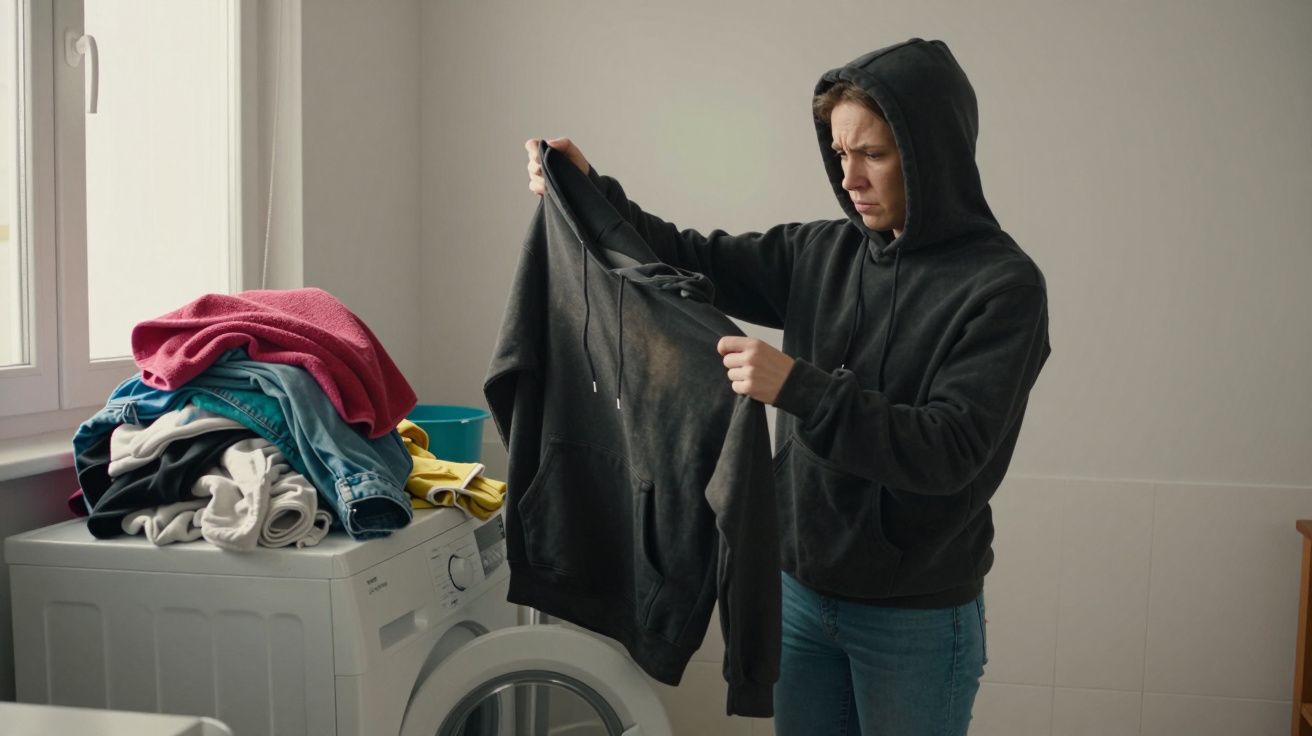
You know that tiny jolt of annoyance you get when you pull your “good” black jeans out of the wash and they already look… tired? The waist still fits, the fabric’s fine, but the colour has gone from inky black to a sort of washed-out charcoal after barely a dozen wears. You blame the brand, the water in your area, maybe your ancient washing machine.
You start trying all the classic fixes. Special “black” detergent. A cold wash. Fabric softener that promises to “protect fibres” and keep clothes feeling new. Yet a month later, your T‑shirts have that fuzzy grey look, your leggings have gone streaky at the knees, and your once‑black hoodie looks like it belongs in the “dog-walking clothes” pile.
Behind the scenes, laundry specialists say there is one everyday habit doing most of the damage – and it is the one most Britons are quietly proud of.
The “helpful” habit that’s quietly wrecking your darks
Ask professional launderers what fades black clothes fastest and you expect to hear “hot water” or “cheap dye”. They do matter. But the thing they mention again and again is much more mundane: the big, efficient, mixed wash.
The one where you chuck in everything that is not white – jeans, gym leggings, school jumpers, fluffy towels, tea towels, socks – hit a 40°C mixed cycle, add a pod and a good glug of softener, and feel virtuous because you are saving time, energy and water.
That “one‑basket‑for-everything” habit is the killer.
To you, it feels sensible: fewer loads, less faff, lower bills. To your black clothes, it is like spending an hour in a tumble of sandpaper, hot water and strong chemicals. They do not just get clean. They get scrubbed, abraded and gently stripped of dye every single wash.
Why mixed loads are harsher than you think
In a perfect world, your darks would swirl around in soft water with similar, smooth fabrics. In a real British household, they end up wedged between a stiff cotton towel and your partner’s heavy denim, doing 1,200rpm in hard water full of limescale.
Laundry techs describe three main problems with the “everything in together” approach:
- Friction: Rough fabrics (towels, heavy cottons, zips, Velcro) rub against softer, dyed fibres. Each rub lifts away microscopic bits of pigment, especially on areas that already take a beating – knees, seams, collars.
- Lint: Light‑coloured lint from towels and jumpers sticks to black clothes. Even when the dye is intact, that fine fuzz gives blacks a dull, greyish cast.
- Chemistry + time: Standard bio detergents, optical brighteners and longer 40°C cycles are brilliant for stains but harsher on dark dye. In a crowded drum, clothes need more time and more chemistry to come out visibly “clean”.
Put simply: every time you do that heroic, overstuffed dark wash, you are trading colour for convenience.
What looks like efficiency on laundry day looks like premature greying three weeks later.
What’s actually happening to the dye?
Most black clothes are not one solid, magical black. They are a cocktail of different dyes layered onto cotton, viscose, polyester or a blend. Those dye molecules cling to the fibres – until heat, alkaline detergent and friction persuade them to let go.
When you cram the drum:
- The surfaces that touch the drum walls and other garments get constant rubbing, so the outermost fibres on those surfaces fray and shed more quickly.
- High spin speeds and hot rinses encourage microfibre shedding, carrying dye away with them.
- Optical brighteners designed to make whites look “whiter” can leave a slight greyish film on dark fabrics, making blacks look dusty rather than deep.
Your eyes do not notice a tiny bit of dye loss from one wash. But multiply that by three loads a week, add a few tumble‑dry sessions, and your “new” polo shirt has aged five years in a school term.
The simple shifts that keep black clothes black
You do not need a separate laundry room and a shelf full of mysterious products. You just need to stop treating your black clothes like everyone else’s bath towels.
1. Give your blacks (and other deep colours) their own load
This is the biggest, most effective change. When you wash blacks with:
- Other smooth, dark items (navy, charcoal, dark denim), and
- No fluffy towels, fleece blankets or lint‑bomb jumpers,
you drastically cut down friction and lint.
If you have a small household and worry about half‑loads, wait an extra day or two until you can fill the drum to about three‑quarters. A machine that is slightly under‑filled is far kinder to clothes than one rammed to the door.
2. Wash cooler and shorter than you think
For most everyday black items:
- Aim for 20–30°C on a short or “delicates” cycle.
- Save 40°C for truly grim sports kit or heavily soiled items.
- Avoid “intensive” or “cotton hygiene” cycles for fashion pieces and school uniform jumpers.
Modern detergents are built to work in cool water. The extra 10 degrees do far more for fading than for cleanliness on a lightly worn black T‑shirt.
3. Turn everything inside out
It feels trivial. It is not.
Turning jeans, leggings and T‑shirts inside out means:
- The side that shows suffers less friction and fewer scuffs.
- Any lint clings to the inner surface, not the outer one.
It adds 30 seconds before you press “Start” and buys you months of extra wear before the colour looks tired.
4. Pick the right detergent – and use less
Two quiet rules laundry specialists swear by for dark loads:
- Use a liquid detergent or gel for darks; powders and tablets can leave residues that look chalky on black.
- Avoid detergents heavily sold as “whitening” or “brightening”; look for “colour care” or “for dark clothes” instead.
Then, the bit most of us resist:
Use the lower end of the dosing guidance unless the clothes are properly filthy. More detergent does not mean more clean; it just means more chemicals attacking the dye and more residue stuck in the fibres.
5. Go easy on fabric softener
Those blue liquids so many British households swear by make towels feel fluffy, but they are not great friends to black clothes.
Softener works by coating fibres. On dark items, that can:
- Trap lint and dust, making everything look slightly chalky.
- Build up into a film that makes fabrics look dull rather than deep.
If you love the scent, use a tiny amount – or skip it entirely on black loads and let your detergent and a decent spin do the work.
6. Rethink the tumble dryer
Heat is one of the quickest routes from black to murky grey. A hot tumble cycle:
- Accelerates fibre wear and microfibre loss.
- Bakes in any residue left from detergent and softener.
Where you can, air‑dry blacks flat or on hangers, away from direct sunlight and radiators. If the tumble dryer is non‑negotiable, stick to:
- Low heat
- Shorter cycles
- Removing items while they are still slightly damp and finishing them on a hanger
If you cannot face doing separate dark loads
Some weeks, the idea of yet another category of washing is a hard no. Laundry specialists are realistic about that.
When life is chaotic and you genuinely need to throw everything in together, prioritise these three things:
- Zip everything up and turn darks inside out.
- Drop the temperature to 30°C.
- Skip the towels and fleece in that load if you possibly can.
Those micro‑adjustments do not give you perfect, museum‑piece blacks, but they significantly slow the slide from “new” to “grey and fuzzy”.
Habits that help vs habits that hurt your blacks
A quick snapshot, when you are standing in front of the machine wondering what actually matters:
| Habit | Effect on black clothes |
|---|---|
| Separate dark load, 20–30°C, short cycle | Keeps dye richer for longer, less lint and friction |
| Turning items inside out, zips done up | Reduces visible scuffing and patchy fading |
| Using liquid “colour care” detergent, modest dose | Gentle on dye, less residue, fewer grey patches |
| Regular fabric softener in every dark load | Duller finish, more lint and a “dusty” look |
| Crammed mixed load with towels at 40°C | Fastest route to greying, pilling and worn‑looking seams |
When the fading is not really your fault
There is one uncomfortable truth: some black clothes are doomed from the start.
Cheaper, fast‑fashion pieces are often:
- Dyed quickly with less stable black pigments
- Made from blends that do not hold colour well
- Pre‑washed at high temperatures in the factory
That does not mean you should not buy them, but it does set expectations. Even perfect laundry habits cannot turn a £6 black T‑shirt into a heirloom.
What you can do is stop your routine from speeding up the fade. When you protect the colour you paid for, your clothes last longer, look more expensive than they were, and you are not constantly re‑buying the same basics every term.
FAQ:
- Do I really need a special detergent just for black clothes? Not strictly, but a liquid “colour care” detergent without optical brighteners is kinder to dark dye. If you prefer to keep things simple, use any good quality liquid and focus on cooler temperatures and gentler cycles.
- Is cold water enough to get smells out of sportswear and leggings? Often yes, if you wash soon after wearing and do not overload the machine. For stubborn odours, use a sports-specific detergent or add an occasional 40°C wash, but keep everyday cycles cooler.
- My area has very hard water – does that make fading worse? Hard water can leave mineral deposits that make blacks look dull. Using a water‑softening product or a slightly higher dose of liquid detergent can help, but the biggest gains still come from less friction, cooler washes and careful drying.





Comments (0)
No comments yet. Be the first to comment!
Leave a Comment