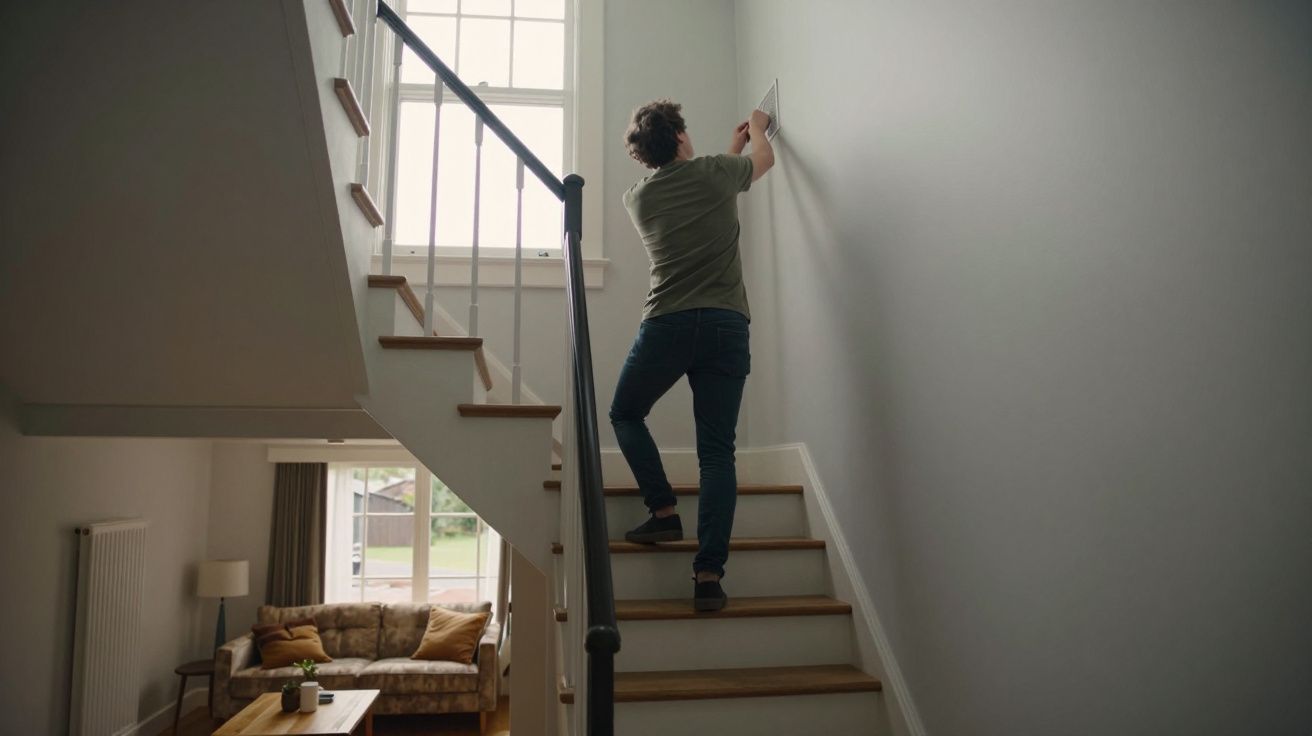
You notice it halfway up the stairs. That small shiver as you move from a warm living room into an upstairs that feels like a different season. The thermostat downstairs insists everything is fine. The boiler has had its service. Yet you’re brushing your teeth in a jumper and sleeping under an extra throw, wondering how on earth the bedroom can feel this chilly when “heat rises”, as everyone keeps reminding you.
So you do what most of us do: tap the thermostat up a degree, maybe two, and hope your energy bill doesn’t notice. The radiators hiss, the boiler hums, and still there’s that thin, persistent draught licking around the landing and seeping under bedroom doors. It feels mysterious and expensive, like the house is quietly working against you.
When you finally call someone out, the heating engineer barely glances at the boiler. They walk past your immaculate thermostat, climb the stairs, and reach up to a slim plastic strip above the landing window. A tiny click of a vent you’ve never really registered, a small adjustment of the slider - and the whole upstairs begins to feel different within days.
Not magic. Just air. And one overlooked vent doing more work than you think.
The little vent doing a big job
Look up at the top of your window frames and you’ll probably see it: a narrow, louvred slot with a simple slider. That’s your trickle vent. It’s there to let a small, steady stream of fresh air in, even when the window is closed. It fights condensation, mould, and that stuffy “shut in” feeling in modern, well-sealed homes. It’s doing an important job.
But left fully open on an exposed upstairs wall all winter, particularly on the landing, it can also drag just enough cold air in to make the whole floor feel colder than it reads on the thermostat. The landing is the crossroads of your upstairs: air from every room passes through it. A chilly draught here spreads that coolness around like gossip.
One engineer from Sheffield put it bluntly:
“People will spend hundreds on smart controls, then leave a vent the size of a KitKat on full blast above the coldest part of the house.”
The aim is not to shut these vents permanently. It’s to adjust them so they keep doing their ventilation job without acting like a permanent crack in the window when you most need warmth.
Why upstairs feels colder even though “heat rises”
The phrase is true and misleading at the same time. Warm air does rise - but then it escapes, especially at the top of the house. That escape creates a gentle suction that pulls cold air in lower down. Heating engineers call it the stack effect. You mostly feel it as “Why is the landing freezing again?”
Here’s the loop, in plain English:
- Radiators warm the air.
- Warm air drifts upwards towards the first floor and loft.
- It leaks out through gaps around loft hatches, roof timbers, and, yes, open trickle vents and bathroom vents.
- As it leaks out at the top, the house has to replace that air, so colder air gets pulled in through gaps at ground level.
Downstairs, the thermostat might be happy because the living room is cosy and sheltered. Upstairs, the combination of heat escaping high up and fresh cold air sneaking in through vents makes bedrooms and landings feel stubbornly cool, even when the boiler is working hard.
Add one more ingredient: most of us leave internal doors open upstairs. That turns the stairwell into a gentle chimney. Warm air whooshes up, meets a cold vent or a leaky loft hatch, and disappears. You’re left standing in a flow of air that’s constantly being replaced, just cool enough to make you reach for another layer.
How to adjust that overlooked vent without causing damp
The trick isn’t to declare war on ventilation. It’s to manage where and how it happens so you’re not pointlessly cooling the areas you spend the night in.
Try this five‑minute check on a chilly evening:
Find the culprits
- Walk around upstairs and look for slim vents above window frames.
- Pay special attention to the landing window, stairwell, and the coldest bedroom.
- Walk around upstairs and look for slim vents above window frames.
Feel the air
- On a breezy day, hold the back of your hand a few centimetres below each vent.
- Notice which ones are sending a definite cool stream down the wall.
- On a breezy day, hold the back of your hand a few centimetres below each vent.
Adjust, don’t annihilate
- Most trickle vents have a small slider or flap. Try setting upstairs vents to half open in winter, rather than fully open.
- In the coldest room or on an exposed gable wall, you may choose to close the vent overnight and reopen it in the morning.
- Most trickle vents have a small slider or flap. Try setting upstairs vents to half open in winter, rather than fully open.
Prioritise the “wet” rooms
- Keep kitchen and bathroom extraction working properly - that’s where moisture really builds.
- A slightly reduced trickle in bedrooms can be balanced by good extraction when you cook, shower, or dry clothes.
- Keep kitchen and bathroom extraction working properly - that’s where moisture really builds.
Watch what happens over a week
- Has that icy edge on the landing softened?
- Are windows still reasonably clear in the mornings, or do you see heavy condensation and black mould patches getting worse?
- Has that icy edge on the landing softened?
If condensation suddenly blooms or walls start smelling musty, you’ve gone too far. Slide those vents back open a notch. Background ventilation is not optional in a modern, airtight home; it just doesn’t need to be on full blast in the most exposed upstairs spots all winter.
One rule you mustn’t break
Not all “holes in walls” are created equal. Some vents are safety‑critical, especially:
- Permanent vents near gas fires or boilers.
- Air bricks supplying combustion air.
- Chimney and flue vents.
Never tape over, block, or close these. If you’re unsure what a vent is for, treat it as non‑negotiable until a qualified professional says otherwise.
Trickle vents in window frames are designed to be adjustable. Combustion vents are not.
Other small tweaks that help upstairs feel less Arctic
Adjusting trickle vents tackles the cold airflow. A few other tiny habits help lock the warmth in once you’ve stopped so much of it leaking away.
Close doors at night
Shut bedroom and bathroom doors and consider closing the door at the bottom of the stairs. You’re turning that big, leaky chimney into smaller, easier‑to‑heat pockets.Bleed radiators that feel hot at the bottom, cool at the top
Air trapped in upstairs radiators means less heat reaching the room. Use a radiator key and a cloth, open the little bleed vent until water, not air, comes out, then close it firmly.Check the quiet valve on each radiator
The lockshield valve (usually the one with a plain cap) controls how much hot water flows through. If downstairs radiators are scorching and upstairs ones are merely warm, a heating engineer can “balance” the system so more heat heads upstairs. It’s not a vent, but it changes the story.Look at the loft hatch
If cold air spills around the hatch, you may be missing a simple draught seal. A basic foam strip can reduce that icy waterfall of air without touching essential roof ventilation.
Here’s a quick guide to what you might notice, what it often means, and where to start:
| What you feel/see | Likely culprit | First thing to try |
|---|---|---|
| Chilly breeze on landing near window | Trickle vent wide open | Set vent to half or ⅓ open |
| Upstairs rad hot at bottom, cool at top | Air trapped inside | Bleed the radiator |
| Bedrooms cool, living room roasting | System unbalanced + stack effect | Ask for radiator balancing; shut doors |
You don’t have to fix every last watt of heat loss. You just need to nudge the balance back in your favour.
A tiny “vent ritual” when the weather turns
Treat your upstairs like you treat your wardrobe when autumn bites. You wouldn’t wear July’s T‑shirt on a frosty November morning and expect to feel fine. Your vents need that seasonal nudge too.
Once when the clocks change in autumn, and again in spring:
- Walk the upstairs circuit.
- Set bedroom and landing trickle vents to a winter position (often half open rather than fully).
- Check that bathroom and kitchen extraction still works properly.
- Bleed any sulky upstairs radiators.
- Run a hand around the loft hatch and big window frames for obvious draughts.
It’s ten minutes, tops. Yet the next time you climb the stairs with a cup of tea and don’t get slapped by that temperature drop, you’ll feel the payoff in your bones.
What this small fix actually buys you
No, sliding a tiny bit of plastic won’t magically turn a draughty Victorian terrace into a passive house. But it does something quieter and more powerful: it gives you back a sense of control.
The bedroom no longer feels like a tent. The kids stop complaining their toes are freezing when they get out of bed. You find yourself nudging the thermostat down a fraction instead of up, because the whole house feels more even. Over a winter, that’s real money, not just comfort.
Most of our heating lives aren’t about big renovations or shiny new boilers. They’re made up of these small, slightly boring adjustments that quietly decide whether you sleep well or lie there listening to the wind whistle through the gap above the stair window.
Nudging a trickle vent isn’t glamorous. It won’t impress anyone on Instagram. But the next time you walk up the stairs and don’t feel that familiar shiver, you’ll know exactly which little piece of plastic helped. And once you’ve felt that difference, it’s hard to go back to pretending that upstairs cold is just “how the house is”.
FAQ:
- Is it safe to close trickle vents completely in winter?
Occasionally and temporarily, yes, in a bedroom that feels brutally exposed. But keeping some background ventilation open elsewhere in the house is important to control moisture and mould.- Will adjusting vents fix every cold‑upstairs problem?
No. Insulation, window quality, radiator size, and system balancing all matter. But vents are a low‑effort first step that often takes the sharp edge off the chill.- What if my windows don’t have trickle vents?
Older windows may rely on natural gaps. Focus on bleeding radiators, sealing obvious draughts around frames, and checking loft insulation and the hatch seal instead.- Can I just tape over the vents to stop the draught?
It’s not recommended. Tape can trap condensation inside the frame and encourage mould. Use the built‑in slider or flap to control airflow instead, and speak to a professional if the draught feels extreme.



Comments (0)
No comments yet. Be the first to comment!
Leave a Comment