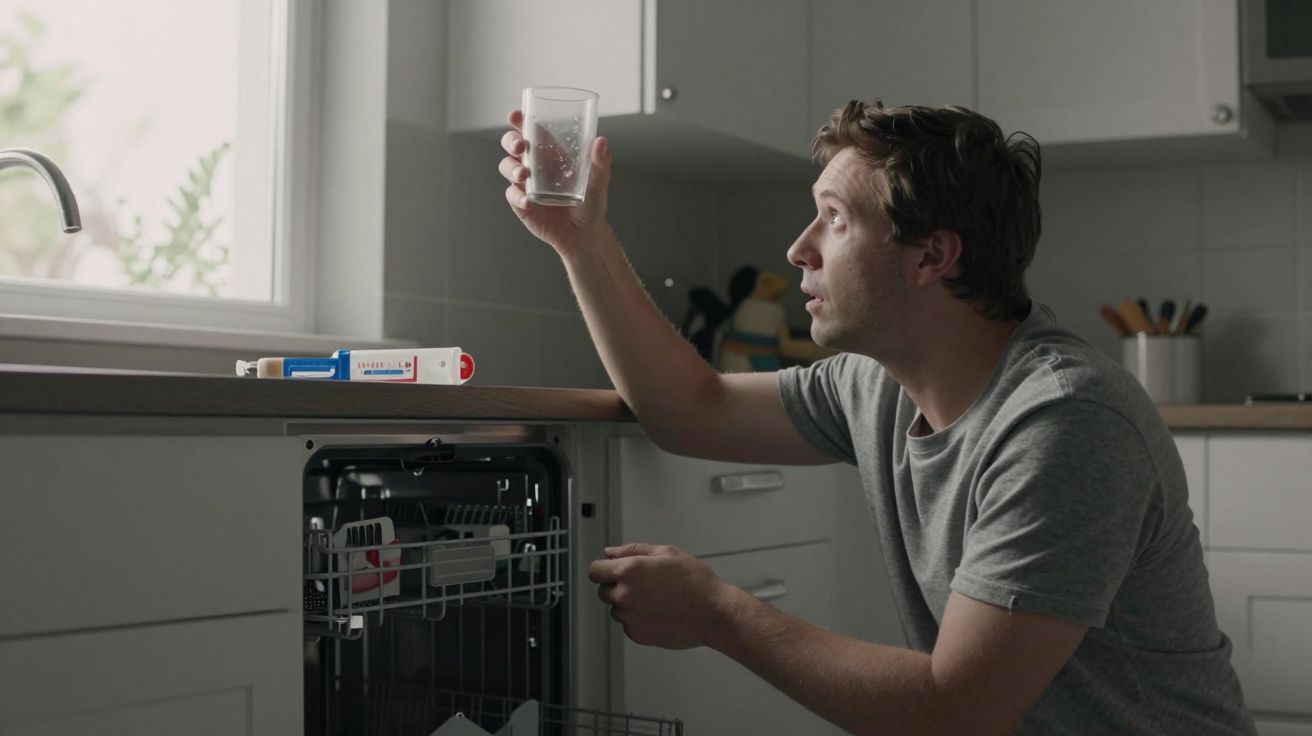
The glasses came out of the dishwasher looking clean enough, if you didn’t look too closely.
You held one up to the window and there it was again: that milky film that makes even new glasses look like they’ve lived three lives in a student house. You wipe it with a tea towel, it improves a bit, but never quite goes back to the clear, sharp sparkle they had when you unboxed them.
Some people blame cheap detergent. Others buy “glass-care” tablets, or give up and start hand-washing anything vaguely nice. Meanwhile, hidden behind a tiny cap in the bottom of the machine, the actual culprit is quietly doing its job… badly tuned.
Many technicians will tell you the same thing: in hard‑water areas, the number‑one cause of cloudy glasses is not your tablets. It’s a dishwasher salt setting that doesn’t match your tap water – and most people have never touched it.
Why your glasses are turning cloudy
Technicians see two main types of “cloudy” glasses, and they behave very differently.
The first is a chalky, slightly rough film that sometimes leaves drip marks or white spots. You can usually shift it with vinegar, lemon juice, or a run through the dishwasher with a descaler. This is limescale: dissolved minerals from hard water crusted onto the glass.
The second is more sinister: a deep, even cloudiness or rainbowy “frosted” look that never quite wipes off. Sometimes the surface even feels a bit etched. That’s not dirt – it’s permanent glass corrosion. Once you’re there, there’s no going back.
Water hardness and salt settings can nudge you towards one or the other:
- Too hard (not enough salt / hardness set too low): minerals stay in the wash water and dry onto your glasses as limescale.
- Too soft (too much softening / hardness set too high): the water becomes aggressive, especially with hot cycles and strong detergents, and the glass surface slowly erodes.
The aim is not “as soft as possible”. The aim is the right softness for your postcode and your glasses.
What dishwasher salt actually does (and why the setting matters)
Inside most dishwashers sold in the UK there’s a small built‑in water softener – a chamber filled with resin beads.
Those beads swap the calcium and magnesium in hard water (the stuff that makes your kettle furry) for sodium. Over time the beads “fill up” and have to be rinsed with a salty solution to reset them. That’s what dishwasher salt is for: it regenerates the softener so it can keep doing the swap.
The catch is that the machine has to know how hard your incoming water is, so it can decide:
- how often to regenerate the resin
- how much salty solution to use
That’s where the “water hardness” or “salt” setting comes in. On most machines it’s hidden in a menu or adjusted via small button presses at start‑up. Out of the box, manufacturers often set it to a middle value that is wrong for large chunks of the UK.
“Nine homes out of ten that I visit have never had the hardness set correctly,” says Dan, a domestic appliance engineer in the South East. “People top up the salt, but the machine’s still treating London water as if it lives in the Lake District.”
If the setting is too low for your area, the softener doesn’t regenerate often enough. Hard water sneaks through, laying limescale on glasses, heating elements and spray arms. If it’s too high, you waste salt, risk over‑softening and creep closer to glass corrosion – especially on high‑temperature cycles.
How to match your salt setting to your tap water
You do not need to be an engineer to get this right. You just need three bits of information and ten quiet minutes.
1. Find out how hard your water actually is
In the UK, this is usually free and ridiculously underused. You can:
- Check your water company’s website with your postcode (“water hardness” tool).
- Look at the annual water quality report they send you by email or post.
- Use a cheap test strip kit if you’re on a private supply or unsure.
You’re likely to see hardness given as °dH, ppm, mg/l, Clark or French degrees. Write down the number and units – you’ll need them.
2. Translate it into your machine’s scale
This is the bit most people skip. Your dishwasher manual will have a table that looks something like:
- H01–H03 = soft water
- H04–H05 = medium
- H06–H07 = hard, etc.
Match your real hardness to the range in the table, then note which setting your machine wants. If you’ve lost the paper booklet, search online for “brand model number water hardness setting PDF” – they’re almost all available.
If your water is marked “hard” or “very hard” in the report and you’ve never changed the factory setting, there’s a good chance it’s currently too low.
3. Change the setting on the dishwasher
Each brand hides this in its own way – often via a combination of:
- turning the machine on with no programme selected
- holding a button (or two) for several seconds
- pressing another button to step through H01, H02, H03…
- pressing Start to save
Follow the sequence in the manual once, slowly. You only have to do this again if you move house or switch water supply.
4. Keep using proper dishwasher salt – even with “all‑in‑one” tablets
This is the bit technicians repeat on loop.
- Use coarse dishwasher salt only, never table or rock salt (they can clog valves).
- Keep the reservoir at least half full – don’t wait for the “no salt” light to flash for days.
- Wipe any spilled salt from the base so it doesn’t cause surface rust.
All‑in‑one tablets can help in soft to moderately hard water. In much of the UK, they’re not enough on their own. The built‑in softener doing its job properly is what protects both your glasses and the machine.
Here’s a simple cheat sheet you can screenshot and keep:
- Look up your postcode’s water hardness this week.
- Find your dishwasher’s hardness table (manual or PDF).
- Set the machine to match your real hardness, not the default.
- Keep the salt reservoir topped up with proper dishwasher salt.
- Re‑check the setting if you move or notice a change in water feel or limescale.
Other small tweaks technicians swear by
Once your salt and hardness are sorted, a few quiet habits make a big difference to cloudy glassware and the life of the machine.
Rinse aid is not a scam
Rinse aid helps water sheet off surfaces instead of drying in droplets, which reduces spots and streaks. In hard‑water areas, technicians almost always recommend:
- using separate salt + rinse aid + tablets, rather than relying purely on “3‑in‑1”
- starting with the middle rinse‑aid dosage setting, then nudging up or down depending on spotting
If you hate strong fragrances, look for unscented or “glass-friendly” rinse aids instead of turning it off entirely.
Don’t always blast the hottest cycle for glasses
Very high temperatures, long cycles and aggressive detergents are more likely to cause permanent etching on delicate glass, especially if your water is on the softer side.
A simple rule:
- Use eco or “glass” programmes for everyday glasses.
- Save the hottest intensive cycles for greasy pans and very dirty loads.
Load so the water can actually rinse
Cloudiness sometimes isn’t chemistry – it’s just poor rinsing.
- Avoid nesting glasses tightly together where water can’t reach.
- Angle glasses so water runs out, not into deep pockets.
- Don’t block the detergent dispenser with a chopping board or huge plate.
“The machine can only clean what the water can touch,” as one technician put it. “Half my ‘mystery’ cloudiness calls are just overloaded top racks.”
Let your next load be the clean slate
There’s something oddly satisfying about the first time you open the dishwasher after fixing the salt setting and see glasses that actually shine again. No vinegar bath. No hand‑polishing in front of the telly. Just clear glass straight from the rack.
Most people live for years with a vague disappointment in their dishwasher, blaming “our water” or “modern machines”, when the fix was tucked away behind a plastic cap and two pages of the manual.
You don’t need new tablets, a new glass set, or a new appliance to stop the slow fog creeping over your cupboard. You mostly need your salt doing the job it was designed for – at the setting your tap water deserves.
| Key point | Detail | Why it matters to you |
|---|---|---|
| Water hardness must match the salt setting | Your machine’s default is rarely right for your postcode. | Correct tuning stops limescale and reduces the risk of glass corrosion. |
| Salt is still essential in hard‑water areas | Built‑in softeners need proper dishwasher salt to work. | Protects glasses and extends the life of the dishwasher itself. |
| Small habits add up | Rinse aid, gentler cycles for glass, sensible loading. | Turns “cloudy and annoying” into “clear without thinking about it”. |
FAQ:
- Do I still need dishwasher salt if I use 3‑in‑1 or all‑in‑one tablets?
In much of the UK, yes. Tablets alone rarely provide enough softening for hard or very hard water. The built‑in softener, fed with proper dishwasher salt and correctly set, does most of the real work.- How can I tell if the cloudiness is limescale or permanent etching?
Try soaking a cloudy glass in warm water with a splash of white vinegar for 10–15 minutes, then rinse. If the cloudiness improves, it was limescale. If it looks unchanged, the glass surface is likely etched and cannot be fully restored.- Can I damage my dishwasher by setting the hardness wrong?
Setting it too low in a hard‑water area can lead to limescale build‑up on heating elements, spray arms and sensors, reducing performance and shortening the machine’s life. Setting it slightly too high mainly wastes salt and, in combination with hot cycles and strong detergent, may encourage glass corrosion.- My kettle furs up quickly – what should I set the dishwasher to?
Rapid kettle scale usually means hard water. Look up the actual hardness from your water supplier and choose the range in your dishwasher manual that matches “hard” or “very hard”, rather than guessing.- How often should I check or adjust the salt setting?
Once it’s correctly set for your address, you can usually leave it alone. Re‑check if you move house, change water supplier, or notice a sudden change in limescale build‑up or how your detergent behaves.




Comments (0)
No comments yet. Be the first to comment!
Leave a Comment