The chair you love most probably tells a story. It’s where you read, doom‑scroll, watch dramas and nod off after Sunday lunch. It might also be the place your lower back quietly complains every time you stand up - that small wince you now think of as “just getting older”.
Osteopaths see a different pattern. They talk about “armchair backs” and “sofa hips”: people over 50 sinking into seats that are simply too low and too soft for joints that don’t bounce back like they used to. The villain isn’t comfort itself, but the angle your hips, knees and spine are forced into for hours at a time.
You don’t need a designer recliner or a medical throne. You do need a seat that meets your body halfway. And for most over‑50s, that starts with one unglamorous number: height from floor to seat.
Why low, squishy chairs are suddenly a problem
In your 20s, dropping into a soft sofa and springing up again makes almost no dent in your day. By your 50s and 60s, joints have changed. Discs in the spine dry out a little, cartilage thins, muscles recover more slowly. Getting out of a low chair becomes a mini squat you didn’t intend to train for.
Osteopaths describe the same pattern in clinic notes: a favourite chair that sits “just a bit low”, a rounded slouch that feels relaxing, then a sharp twinge when standing up. Over time, that repeated strain stiffens the lower back and grinds on knees and hips that may already be arthritic.
The mechanics are simple:
- A low seat forces your hips into a tight bend and tilts your pelvis backwards.
- That rounds the lower spine, loading the discs and ligaments instead of letting the muscles share the work.
- When you stand from too low down, you need more momentum and arm‑pushing, which ramps up forces through knees and lower back.
None of this is dramatic. It’s gradual, which is why people often don’t connect that cosy chair to the stiffness that greets them in the morning.
The osteopaths’ rule of thumb for ideal seat height
Ask five osteopaths and you’ll hear slight variations, but the core advice is the same: for most over‑50s, your seat needs to be a touch higher than you think.
The practical rule of thumb:
Your ideal seat height is roughly the distance from the floor to the crease behind your knee, minus 2–3 cm, so your feet sit flat and your hips are level with or slightly higher than your knees.
In plain terms:
- Feet flat, weight evenly spread through the soles.
- Knees at about 90°, or just under (so your thighs slope very slightly down towards your knees).
- Hips level with or a little higher than knees, never lower.
For many people, this means:
- Average‑height adults: seat height around 44–48 cm
- Taller adults: often 48–52 cm
- Shorter adults: sometimes 40–44 cm
These are starting points, not laws. Leg length, hip and knee arthritis, and any replacements or mobility issues all tweak the ideal. The key is the angles, not the exact centimetres.
How to test your current favourite chair
You don’t need a clinic or a gait lab. You need a tape measure and two minutes.
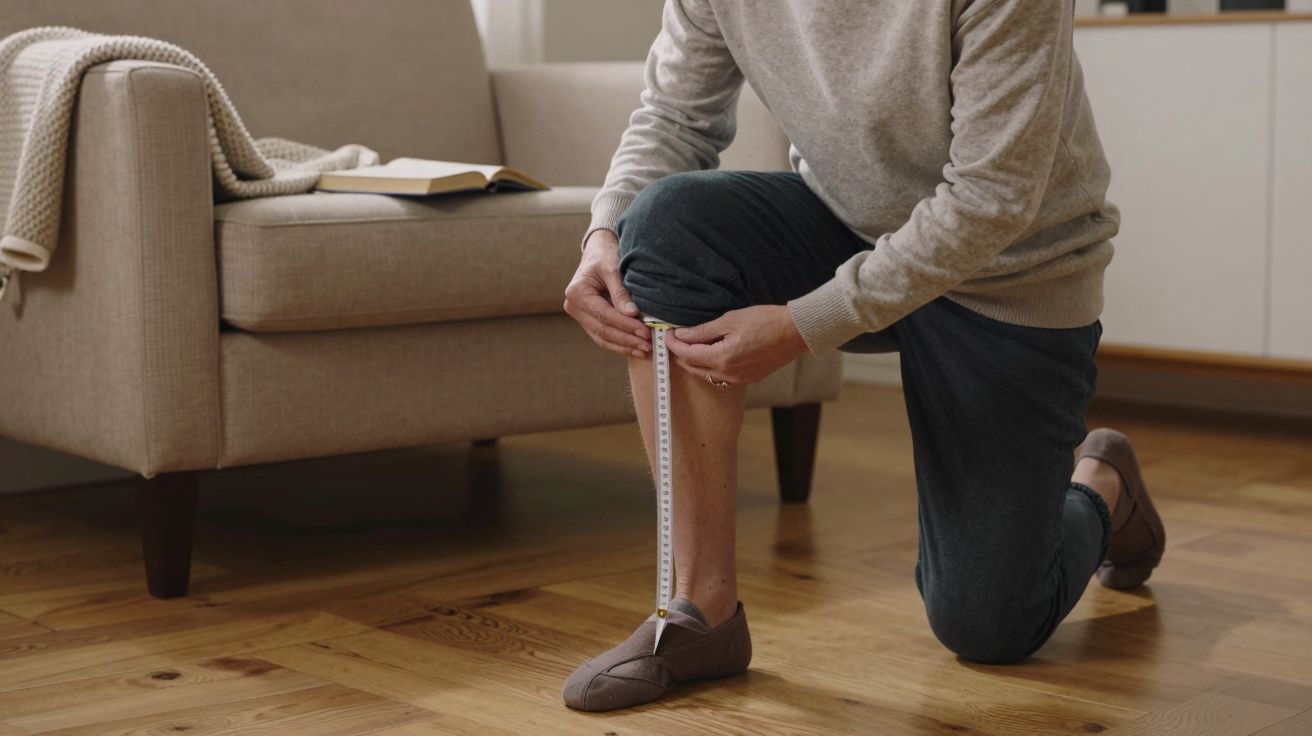
Measure your leg
- Stand barefoot with your usual posture.
- Measure from the floor to the crease behind your knee.
- Subtract 2–3 cm. That’s your rough target seat height.
Measure the chair
- Measure from the floor to the top of the bit of the cushion you usually sit on (not the frame).
- If it’s more than 3–4 cm lower than your target, your chair is effectively “too low”.
Do the sit‑stand test
- Sit back in your normal way, then stand up without using your hands if you safely can.
- Notice: Do you have to rock forwards? Do your knees groan? Does your back protest? That’s your body telling you the setup is working too hard.
A simple summary:
| Check | How to do it | What you’re looking for |
|---|---|---|
| Leg vs seat height | Measure knee crease to floor; compare to chair | Seat within ~2–3 cm of your ideal |
| Feet & angles | Sit, feet flat, look at knees vs hips | Hips level with or slightly above knees |
| Sit‑stand effort | Stand without hands (if safe) | Movement feels steady, not a heave |
If your chair fails all three, it’s not your age alone making you stiff - it’s physics.
Fast fixes if you can’t replace the chair
Not everyone wants (or can afford) to bin the family sofa. Osteopaths are pragmatic: start by raising the seat and supporting the spine, then tweak your habits.
Try:
Firm booster cushion
A dense foam or folded blanket under your sitting bones can add 3–6 cm of height. The cushion should be firmer than the sofa so you don’t sink straight through it.Wedge cushion for pelvic tilt
A wedge with the higher edge at the back gently tips your pelvis forwards, restoring a natural lower‑back curve even on a soft seat.Use the backrest properly
Shuffle your bottom all the way back, then place a small cushion or rolled towel in the small of your back. This supports the lumbar curve instead of letting it collapse.Armrest assist, not armrest dependence
It’s fine to use your hands to guide yourself up, but aim to do most of the work with your legs. If you can’t, your chair is likely still too low.
Let’s be honest: nobody adjusts every chair they sit on. Start with the one you spend most time in - the TV chair, the reading spot, the desk where you do emails. That’s where the biggest gains live.
Micro‑moves that undo long sitting
Seat height is the foundation. Movement is the insurance policy.
Just as “exercise snacks” help office workers, tiny bursts of motion help ageing backs cope with inevitable sitting. Osteopaths often suggest little, frequent changes instead of one heroic stretch at bedtime.
Between episodes, ad breaks or chapters:
30‑second hip unroll
Stand, hold the back of the chair, gently swing one leg forwards and backwards 10–15 times, then swap.Wall reach
Stand with your back to a wall, heels a hand’s width away. Gently lengthen the back of your neck and press the back of your head and shoulders towards the wall for 20–30 seconds.Ankle pumps in the chair
Staying seated, straighten one knee a little and flex and point your foot 15–20 times. Helps circulation and eases stiff calves before you stand.90‑second walk‑about
Simply walk to the kitchen and back, or up and down the hall. The goal isn’t steps; it’s breaking the spell of being stuck in one shape.
These tiny resets stop your spine and hips from moulding themselves to the shape of the chair.
What changes when you raise the seat by a few centimetres
The height difference sounds trivial. The body disagrees.
When your hips are higher and your thighs slope slightly down:
- Your pelvis tips forwards, supporting the natural curve in your lower back.
- Your hip and knee joints move closer to mid‑range, where they bear load more comfortably.
- Standing up becomes more of a gentle push than a deep squat, sparing knees and spine.
People often report that the first week feels “oddly upright” or “a bit perchy”. Then something quiet shifts: fewer grunts getting out of the chair, less morning stiffness, less need to brace their core every time they lean forward.
This isn’t a cure for serious back disease or arthritis, and it doesn’t replace medical care. But as several osteopaths will tell you, the chair you sit in for three hours matters more than the one you sit in for three minutes.
FAQ:
- Is there one perfect seat height for everyone over 50? No. Leg length, joint health and height all change the ideal. Use the back‑of‑knee rule as a starting point, then adjust until your feet are flat, your hips are level with or higher than your knees, and standing up feels steady.
- What if my feet don’t reach the floor on a higher chair? Use a firm footrest or a stack of books so your feet can press into something solid. Dangling feet strain the lower back and reduce circulation.
- Are recliners bad for my back? Not automatically. Problems start when they are very low, very soft, and used for long periods. If you recline, keep your lower back supported and avoid slumping into a C‑shape.
- Does posture matter more than height? They work together. A well‑set seat height makes good posture possible without constant effort. If the chair is too low, you will round and slouch, however disciplined you are.
- When should I see a professional instead of just adjusting my chair? If back or leg pain is severe, wakes you at night, travels down your leg, or comes with weakness, numbness, or changes in bladder or bowel control, seek medical advice promptly. A seating tweak is not a substitute for proper assessment.




Comments (0)
No comments yet. Be the first to comment!
Leave a Comment